
Catocala cerogama
Guenée, 1852
Yellow-banded Underwing
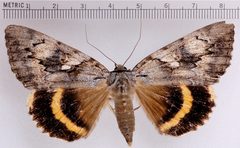
Catocala cerogama, the yellow-banded underwing, is a North American in the Erebidae. are recognized by their brownish-gray forewings and distinctive even, deep yellow bands on the hindwings. The was first described by Achille Guenée in 1852. Adults fly from July through October, and larvae feed on American basswood.

Pronunciation
How to pronounce Catocala cerogama: /ˌkætəˈkeɪlə ˌsɛrəˈɡæmə/
These audio files are automatically generated. While they are not always 100% accurate, they are a good starting point.
Identification
Distinguished from similar Catocala by the even, deep yellow bands on the hindwings (not irregular or broken). The pale band connecting the whitish subreniform spot to the on the forewing is a key diagnostic feature. Forewing coloration is typically brownish-gray rather than the darker or more contrasting patterns seen in some .
Images
Appearance
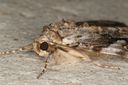
Wingspan 64–81 mm. Forewings brownish-gray with a pale band connecting the whitish subreniform spot to the . Hindwings display even, deep yellow bands. When at rest, forewings are held together over the back, concealing the brightly patterned hindwings.
Distribution
Eastern and central North America: Nova Scotia south to North Carolina, west to Manitoba, South Dakota, and Missouri. Records also include Saskatchewan and Vermont.
Seasonality
fly July through October.
Diet
Larvae feed on American basswood (Tilia americana). feeding habits are not documented.
Host Associations
- Tilia americana - larval food plantAmerican basswood
Life Cycle
Complete . Larval stage feeds on American basswood. occurs mid-summer through autumn.
Behavior
are . Like other underwing moths, they typically rest with forewings folded over the back, concealing the brightly colored hindwings; when disturbed, they may flash the hindwings as a startle defense.
Ecological Role
Larva functions as a folivore on American basswood. may serve as prey for and as potential , though specific ecological interactions are not well documented.
Human Relevance
Subject of interest among lepidopterists and enthusiasts, particularly during National Moth Week events. The is part of the popular underwing moth Catocala, which is frequently spotlighted in citizen science moth surveys due to its distinctive and colorful hindwing patterns.
Similar Taxa
- Catocala concumbensAlso has yellow hindwing bands, but bands are typically more irregular or broken compared to the even bands of C. cerogama; forewing pattern differs.
- Other Catocala speciesMany underwing moths share the general pattern of dull forewings and bright hindwings; C. cerogama is distinguished by the specific configuration of even yellow hindwing bands and the pale forewing band to the .
More Details
Taxonomic history
Originally described by Achille Guenée in 1852. The name Catocala is derived from Greek meaning 'beautiful below', referring to the colorful hindwings concealed at rest.
Observation notes
Like many underwing moths, may be reluctant to come directly to lights or may remain on the periphery of lighted areas; searching nearby vegetation may be necessary to locate specimens.
Sources and further reading
- BugGuide
- Wikipedia
- GBIF taxonomy match
- iNaturalist taxon
- NCBI Taxonomy
- Catalogue of Life
- A Gathering of Lepidopterists: Who's Who of the Butterfly, Moth Experts | Bug Squad
- Got Moths? Celebrate National Moth Week and Global Citizen Science
- Bug Eric: National Moth Week Recap, 2015
- Bug Eric: National Moth Week Recap for Colorado Springs
- Bug Eric: National Moth Week 2024 Recap from Kansas City
- Bug Eric: New Mexico Night Bugs