
Plusiodonta compressipalpis
Guenée, 1852
Moonseed Moth
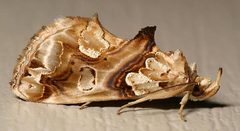
Plusiodonta compressipalpis, commonly known as the moonseed , is a small moth in the Erebidae. The was described by Achille Guenée in 1852. It occurs across eastern North America with two per year in most of its range. The reflects its larval association with moonseed vines (Menispermum species).
Pronunciation
How to pronounce Plusiodonta compressipalpis: /pluː.si.oʊˈdɒn.tə kəmˌprɛsɪˈpæl.pɪs/
These audio files are automatically generated. While they are not always 100% accurate, they are a good starting point.
Identification
The can be confirmed by genitalia examination or by association with larval plants. The two- in eastern North America helps distinguish it from some similar Calpinae with different periods. Dissection or may be required for definitive separation from closely related Plusiodonta species.
Images
Appearance
have a wingspan of 25–33 mm. The forewings are typically grayish-brown with subtle patterning. The lacks prominent diagnostic markings visible to casual observation.
Habitat
Found in deciduous woodlands, forest edges, and riparian corridors where vines occur. Larval specificity to climbing vines creates a patchy distribution tied to Menispermum and Cocculus (snailseed) presence.
Distribution
Eastern North America from Minnesota and extreme southern Ontario east to Connecticut, south to northern Florida and Texas. Core range centers on the eastern deciduous forest biome.
Seasonality
fly from May to September. Two occur across much of the eastern range, with peak activity varying by latitude.
Diet
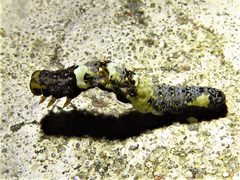
Larvae feed on moonseed (Menispermum canadense and related Menispermum ) and snailseed vines (Cocculus carolinus, formerly assigned to Menispermum). feeding habits are not documented.
Host Associations
- Menispermum canadense - larval Primary ; moonseed vine
- Cocculus carolinus - larval Snailseed vine; formerly Menispermum carolinum
Life Cycle
(two ) across most of range. stage not explicitly documented in sources. Larval development occurs on vines; site unreported.
Behavior
. attracted to light. Larvae are specialized vine feeders, likely climbing stems to reach foliage.
Ecological Role
Herbivore specializing on moonseed (Menispermaceae) vines. Serves as prey for . No documented mutualisms or engineering effects.
Human Relevance
No economic importance. Occasionally encountered by gardeners and naturalists. Used as an for intact deciduous forest with native vine .
Similar Taxa
- Other Plusiodonta species-level similarity in wing pattern; require genitalia or molecular analysis for separation
- Calpinae moths with gray forewingsConvergent coloration; plant association and aid identification
More Details
Taxonomic note
placement has shifted historically; treated as Noctuidae in older literature but currently classified in Erebidae (Calpinae) based on molecular and morphological revision.
Host plant clarification
Literature references to 'snailseed vines' apply to Cocculus carolinus, which was formerly classified in Menispermum; this is a single lineage, not two unrelated plants.