
Plusiodonta
Guenée, 1852
Species Guides
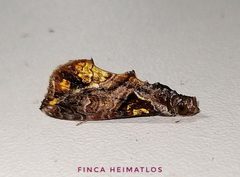
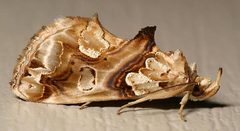
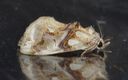
3Plusiodonta is a of in the Erebidae, Calpinae, erected by Achille Guenée in 1852. The genus comprises approximately 40 described distributed across tropical and subtropical regions of the Old World and the Americas. are characterized by distinctive wing with angled outer margins and specialized scaling patterns. Larvae possess two pairs of abdominal , a trait that distinguishes them from many other moth larvae.
Pronunciation
How to pronounce Plusiodonta: /ˌpluː.si.oʊˈdɒn.tə/
These audio files are automatically generated. While they are not always 100% accurate, they are a good starting point.
Identification
Distinguished from similar calpine by the combination of: upturned, roughly scaled palpi reaching above the vertex; forewings with outer margin distinctly angled at 4; inner marginal tufts on forewing with excised margin between them; and male bipectinate . The reduced number of larval (two pairs) is diagnostic. -level identification requires examination of genitalia and wing pattern details.
Images
Distribution
Pantropical and subtropical distribution spanning the Old World and New World. Documented from Southeast Asia (Thailand, Philippines, Borneo, Indonesia), Africa, Madagascar, and the Americas including the United States (Vermont).
Similar Taxa
- Other Calpinae generaShare general body plan and wing shape, but differ in palpi structure, forewing margin angulation, and larval number.
- Erebidae: HypeninaeSimilar slender build but typically lack the distinctive forewing margin excision and tufts characteristic of Plusiodonta.
More Details
Notable Species
Plusiodonta compressipalpis Guenée, 1852 – the moonseed moth, has a documented suggesting potential larval association with moonseed plants (Menispermaceae), though this requires verification.
Taxonomic History
Originally described by Guenée in 1852 within Boisduval and Guenée's work. Recent taxonomic revisions (2017) have added new from Southeast Asia and clarified distributions of previously described .