
Lycomorpha
Harris, 1839
black-and-yellow lichen moths
Species Guides
6- Lycomorpha desertus
- Lycomorpha fulgens
- Lycomorpha grotei(Grote's lycomorpha moth)
- Lycomorpha pholus(black-and-yellow lichen moth)
- Lycomorpha regulus
- Lycomorpha splendens
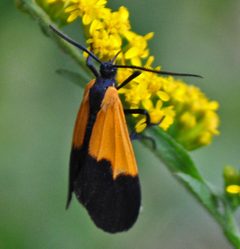
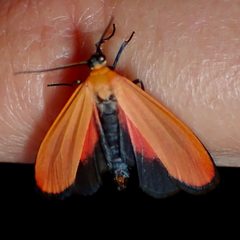
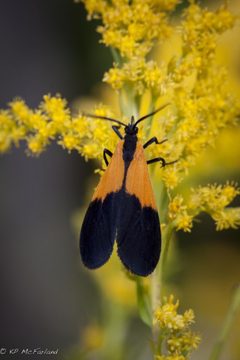
Lycomorpha is a of lichen moths in the Erebidae, established by Thaddeus William Harris in 1839. The genus comprises six described distributed primarily in North America, with some species extending into the Neotropics. Members are known for their striking black-and-yellow or black-and-orange coloration and their participation in Müllerian mimicry complexes with net-winged beetles (family Lycidae). The best-studied species, L. pholus, is exclusively and retains functional hearing despite isolation from bat .
Pronunciation
How to pronounce Lycomorpha: /laɪkoʊˈmɔrfə/
These audio files are automatically generated. While they are not always 100% accurate, they are a good starting point.
Identification
Lycomorpha are distinguished from superficially similar in other by their lichen moth combined with warning coloration patterns. L. pholus specifically differs from the unrelated Pyromorpha dimidiata (Zygaenidae) by lacking the black hind margin on the forewing and by its later in late summer rather than earlier in the season. The can be confused with net-winged beetles (Calopteron and related genera in Lycidae) due to convergent black-and-orange or black-and-yellow aposematic coloration; close examination reveals lepidopteran versus coleopteran wing structure and form.
Images
Distribution
North America, with some extending into the Neotropics. Documented occurrences include the United States (Vermont, Missouri) and broader Neotropical regions.
Seasonality
of L. pholus appear in late summer; other ' not specified in available sources.
Behavior
Members of this participate in Müllerian mimicry complexes involving net-winged beetles ( Lycidae), particularly such as Calopteron terminale. L. pholus is exclusively and, despite this, retains auditory sensitivity to ultrasound and exhibits evasive responses when stimulated, though it does not produce sounds in response to ultrasound. The ears are considered functionally for bat detection but may serve short-distance social communication.
Similar Taxa
- Pyromorpha dimidiataSimilar black-and-yellow warning coloration and shared participation in lycid mimicry complexes; distinguished by black hind margin on forewing and earlier seasonal activity
- Calopteron terminale and other LycidaeConvergent black-and-orange aposematic coloration in Müllerian mimicry association; beetles distinguished by structure and
More Details
Mimicry complex participation
Lycomorpha , particularly L. pholus, are part of a Müllerian mimicry ring centered on net-winged beetles (Lycidae). Unlike some mimics in this complex, L. pholus is itself chemically defended, though the specific compounds have not been characterized in available sources.
Auditory system evolution
L. pholus provides an important case study in sensory system evolution: as an exclusively isolated from bat , it retains hearing capabilities that appear functionally redundant for detection, suggesting maintenance for alternative functions such as intraspecific communication.
Sources and further reading
- BugGuide
- Wikipedia
- GBIF taxonomy match
- iNaturalist taxon
- NCBI Taxonomy
- Catalogue of Life
- Pyromorpha dimidiata | Beetles In The Bush
- Black and yellow lichen moth (suggested common name) Lycomorpha pholus (Drury) (Insecta: Lepidoptera: Noctuidae: Arctiinae: Lithosiini)
- Persistence and regression of hearing in the exclusively diurnal moths, Trichodezia albovittata (Geometridae) and Lycomorpha pholus (Arctiidae)