
Lycomorpha fulgens
(Henry Edwards, 1881)
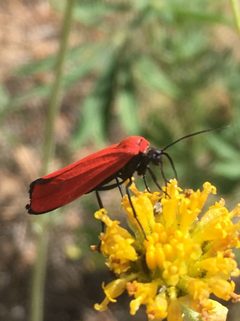
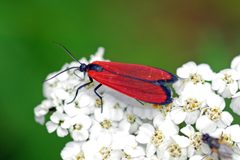
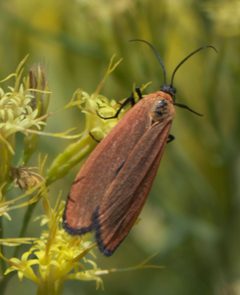
Lycomorpha fulgens is a small in the Erebidae, described by Henry Edwards in 1881. It is restricted to the southwestern United States. The exhibits striking aposematic coloration with predominantly red forewings and black hindwings, characteristic of the lycid mimicry complex to which the belongs.
Pronunciation
How to pronounce Lycomorpha fulgens: /ˌlaɪkoʊˈmɔrfə ˈfʊldʒɛnz/
These audio files are automatically generated. While they are not always 100% accurate, they are a good starting point.
Identification
Distinguished from other Lycomorpha by the combination of predominantly red forewings with black margins and entirely black hindwings. In the southwestern United States, may be confused with Lycomorpha pholus, which has black-and-yellow coloration rather than red-and-black. The similar Pyromorpha dimidiata (Zygaenidae) has a black hind margin on the forewing and different . Visual separation from net-winged beetles ( Lycidae) such as Calopteron terminale requires close examination of and wing venation.
Images
Habitat
Specific associations are not documented in available sources. Based on distribution records, occurs in arid and semi-arid regions of the southwestern United States including oak woodlands and associated vegetation .
Distribution
Southwestern United States: Arizona, California, Colorado, and New Mexico. No records outside this region have been documented.
Ecological Role
Member of the lycid mimicry complex (Müllerian mimicry ring). As with other Lycomorpha , likely contains defensive compounds that contribute to avoidance through shared warning signals with toxic net-winged beetles ( Lycidae).
Similar Taxa
- Lycomorpha pholusOverlapping range but distinguished by black-and-yellow coloration versus red-and-black; appear later in the season (late summer)
- Pyromorpha dimidiataSimilar red-and-black pattern and participates in same mimicry complex, but belongs to Zygaenidae; distinguished by black hind margin on forewing and different
- Calopteron terminaleNet-winged beetle ( Lycidae) that serves as model in the mimicry complex; distinguished by including hardened forewings () and different structure
More Details
Taxonomic Note
Originally described as Anatolmis fulgens by Henry Edwards in 1881, later transferred to Lycomorpha. The genus Lycomorpha was historically classified in (now treated as Arctiinae within Erebidae). The epithet 'fulgens' (Latin for 'shining' or 'glowing') likely refers to the bright red forewing coloration.