
Cycnia tenera
Hübner, 1818
dogbane tiger moth, delicate cycnia
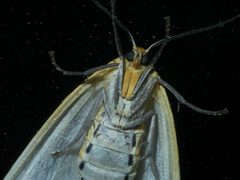
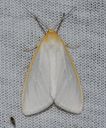
Cycnia tenera, commonly known as the dogbane tiger or delicate cycnia, is a North American moth in the Erebidae. display white wings with buttery yellow forewing margins and a yellow body marked with black spots. The is chemically defended, sequestering cardiac glycosides from its larval plants. It has been extensively studied for its sophisticated anti- defense: emitting ultrasonic clicks that jam bat echolocation and serve as aposematic warnings. The moth occurs across much of North America and flies both day and night.
Pronunciation
How to pronounce Cycnia tenera: //ˈsɪk.ni.ə ˈtɛ.nə.rə//
These audio files are automatically generated. While they are not always 100% accurate, they are a good starting point.
Identification
Distinguished from similar tiger moths by its predominantly white wings with yellow forewing margins rather than bold patterns of black spots or stripes. The yellow body with black spots and black legs are distinctive. Day-flying and association with dogbane or milkweed aid identification. Similar such as other Cycnia or pale tiger moths lack the specific yellow marginal band on the forewing.
Images
Habitat
Open meadows, fields, and disturbed areas where larval plants grow. Associated with dogbane (Apocynum cannabinum) and milkweed (Asclepias) stands. frequent vegetation near host plants and are attracted to lights.
Distribution
Throughout North America from southern British Columbia to Nova Scotia, southward to Arizona and Florida. Present across Canadian provinces including Alberta, Manitoba, and Saskatchewan, and throughout the contiguous United States.
Seasonality
Multiple per year through much of range. active from spring through fall, with peak activity after dusk though individuals fly both day and night. Caterpillars present from June to November.
Diet
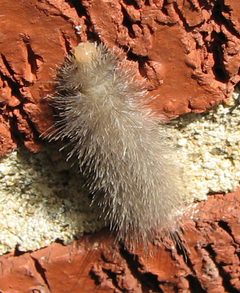
Larvae feed primarily on dogbane (Apocynum cannabinum), with milkweeds (Asclepias spp.) also used in parts of the range. do not feed; they rely on chemical defenses sequestered during larval development.
Host Associations
- Apocynum cannabinum - primary larval Dogbane; produces milky latex containing cardenolides that larvae sequester for defense
- Asclepias - secondary larval Milkweed used in some parts of range
Life Cycle
laid in clutches of 50–100. Larvae feed in during early instars, becoming solitary later. Multiple per year in most of range. stage not explicitly documented in sources.
Behavior
produce ultrasonic clicks via tymbal organs when threatened by bats. Clicks are timed specifically to coincide with the terminal attack phase of bat echolocation, functioning to jam echolocation processing. Males also use clicks to signal females. Adults fly both diurnally and nocturnally, with peak activity after dusk. Larvae feed nocturnally.
Ecological Role
Herbivore that sequesters plant defensive compounds, becoming chemically protected prey. Serves as model for studies of -prey , particularly insect-bat acoustic interactions. Contributes to nutrient cycling through herbivory on dogbane and milkweed.
Human Relevance
Subject of extensive scientific research on anti- defenses and bioacoustics. Occasionally encountered by naturalists and enthusiasts. Not an agricultural pest; larvae feed on weedy native plants. Chemical defense makes it unpalatable and it is not used as food.
Similar Taxa
- Other Cycnia speciesSimilar pale coloration and body shape; distinguished by specific wing pattern of yellow forewing margin and black-spotted yellow body
- Pale tiger moths (Arctiinae)Shared white wing coloration; C. tenera distinguished by yellow marginal band and specific plant associations
More Details
Anti-bat defense mechanism
The tymbal response operates via a closed-loop feedback system that adjusts to stimulus pulse period and intensity. Research demonstrates clicks are emitted during the terminal attack phase rather than early in bat approach, supporting a jamming function over purely aposematic signaling, though both functions may operate simultaneously.
Chemical defense
Sequestered cardiac glycosides from plants provide protection against vertebrate including birds and bats. Bats that capture clicking release them more frequently than muted moths, demonstrating the effectiveness of combined chemical and acoustic defenses.
Sources and further reading
- BugGuide
- Wikipedia
- GBIF taxonomy match
- iNaturalist taxon
- NCBI Taxonomy
- Catalogue of Life
- Bug Eric: Moth Week and "Mothapalooza"
- Monday Moth – Trichaeta pterophorina | Beetles In The Bush
- Archive — Bug of the Week
- Hooray for the red, white, and blue! Milkweed longhorned beetle, Tetraopes tetraophthalmus; dogbane tiger moth, Cycnia tenera; and familiar bluet, Enallagma civile — Bug of the Week
- Do Adult Periodical Cicadas Actually Eat?
- Tingidae | Beetles In The Bush
- Cephalic influences on a defensive behaviour in the dogbane tiger moth, Cycnia tenera
- The Closed-Loop Nature of the Tymbal Response in the Dogbane Tiger Moth, Cycnia tenera (Lepidoptera, Arctiidae)
- Jamming Bat Echolocation: the Dogbane Tiger Moth Cycnia Tenera Times Its Clicks to the Terminal Attack Calls of the Big Brown Bat Eptesicus Fuscus