
Ctenucha rubroscapus
Ménétriés, 1857
red-shouldered ctenucha moth, White-tipped Ctenucha
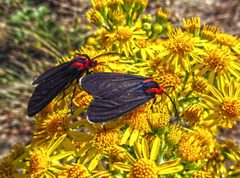
Ctenucha rubroscapus is a tiger moth in the Erebidae, commonly known as the red-shouldered ctenucha . It was described by Édouard Ménétriés in 1857. The is restricted to low-elevation areas of western North America west of the Cascade Mountains. are and visit flowers for nectar. The larvae feed on grasses and sedges in coastal and wetland .


Pronunciation
How to pronounce Ctenucha rubroscapus: /təˈnuːkə ˌruːbroʊˈskæpəs/
These audio files are automatically generated. While they are not always 100% accurate, they are a good starting point.
Identification
Distinguished from other Ctenucha by the combination of red shoulder patches and white-tipped . The Virginia Ctenucha (Ctenucha virginica), found east of the Rocky Mountains, has a similar -mimic appearance but lacks the red shoulder patches and white abdominal tips. The metallic blue-black forewing coloration and help separate it from of similar size.
Images
Appearance
have a black body with bright red-orange patches on the shoulders (), giving rise to the . The forewings are dark with a metallic blue-black sheen. The has white tips on the terminal segments. The wingspan is moderate for the . The forewing length is 19–20 mm.
Habitat
Coastal grasslands adjacent to the ocean, wet boggy meadows, and wet prairie. Occurs at low elevations in the Pacific coastal region.
Distribution
Western North America, specifically limited to low elevations west of the Cascade Mountains, from southern Washington (south of Chehalis) southward through coastal Oregon and California.
Seasonality
are active during daylight hours and have been observed visiting flowers. Specific period not documented in available sources.
Diet
Larvae feed on Poaceae (grasses) and Cyperaceae (sedges), specifically including in the Dactylis and Elymus. feeding habits not documented beyond flower visitation.
Host Associations
- Dactylis - larval food plantgrass
- Elymus - larval food plantgrass
Behavior
activity pattern with visiting flowers for nectar. Exhibits -mimicry with rapid, darting similar to that of spider wasps.
Ecological Role
Larval herbivore in grassland and wetland . may serve as during flower visitation. -mimicry likely provides protection from vertebrate .
Human Relevance
Specimens are curated in entomological collections; the has been featured in museum outreach programs. Not known to be an agricultural pest. Occasionally photographed by naturalists in its native range.
Similar Taxa
- Ctenucha virginicaSimilar -mimic appearance and , but lacks red shoulder patches and white abdominal tips; occurs east of the Rocky Mountains
- Other Ctenucha speciesShare metallic coloration and -mimic , but differ in specific color pattern elements
More Details
Taxonomic history
Originally described as Claucopis rubroscapus by Ménétriés in 1857. The Ctenucha has undergone multiple -level reassignments, formerly placed in , then Noctuidae, and currently in Erebidae ( Arctiinae).
Collection significance
Specimens from California coastal areas have been featured in museum collections and outreach programs, including the Bohart Museum of Entomology at UC Davis.
Sources and further reading
- BugGuide
- Wikipedia
- GBIF taxonomy match
- iNaturalist taxon
- NCBI Taxonomy
- Catalogue of Life
- 'Bee' One in a Million | Bug Squad
- The Insects Around Us: From UC Davis Picnic Day to Your Computer | Bug Squad
- Ready for the Virtual Moth Open House at the Bohart Museum of Entomology? | Bug Squad
- Curator Jeff Smith: Spreading the Wings of Butterflies | Bug Squad
- Bug Eric: Wasp Wednesday: Not Wasp VIII
- Noctuidae | Beetles In The Bush | Page 3