
Tyria jacobaeae
(Linnaeus, 1758)
Cinnabar moth
The cinnabar is a herbivore native to Europe and western Asia, introduced to North America, Australia, and New Zealand for of ragwort. display aposematic black and red coloration advertising their chemical defense. Larvae sequester toxic from plants, rendering them unpalatable to . The has been extensively studied for its , , and multitrophic chemical .
Pronunciation
How to pronounce Tyria jacobaeae: //ˈtɪɹ.i.ə ˌdʒæ.kəˈbeɪ.iː//
These audio files are automatically generated. While they are not always 100% accurate, they are a good starting point.
Identification
Distinguished from other day-flying by the combination of black forewings with two red patches and predominantly red hindwings. Similar burnet moths (Zygaena spp.) have red spots on a dark background but different wing shape and pattern arrangement. The cinnabar moth's specific association with ragwort (Senecio jacobaea) provides additional field identification context.
Images
Appearance
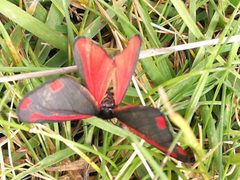
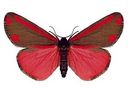
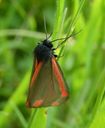
are approximately 20 mm in body length with a wingspan of 32–42 mm. Forewings are predominantly black with two distinctive red patches. Hindwings are mostly red with black margins. The bright red and black pattern is aposematic, warning of . Larvae are black with yellow-orange transverse bands, also displaying warning coloration.
Habitat
Open including pastures, waste ground, coastal sand dunes, and disturbed areas where plants occur. Distribution closely tracks that of Senecio jacobaea. utilize linear landscape structures for movement between host plant patches.
Distribution
Native to Europe and western and central Asia. Introduced to North America, Australia, New Zealand, and East Falkland Islands for . Present in Belgium with records from Brussels-Capital Region and Flemish Region.
Seasonality
emerge in spring and early summer. or partially depending on latitude, with as pupae in soil or leaf litter.
Diet
Larvae are specialized feeders on Senecio jacobaea (ragwort/tansy ragwort). Senecio vulgaris (groundsel) and Jacobaea aquatica are acceptable alternative . Senecio inaequidens is not suitable—larvae fail to survive to . Senecio adonidifolius has been recorded as a newly documented host. feed on nectar.
Host Associations
- Senecio jacobaea - primary larval plantPreferred ; source of sequestered
- Senecio vulgaris - acceptable larval Higher nitrogen content than S. jacobaea; supports larval development
- Jacobaea aquatica - acceptable larval Suitable alternative with equivalent larval performance
- Tussilago farfara - marginal avoid for oviposition; larvae develop poorly, resulting in smaller pupae
- Senecio inaequidens - unsuitable ; females retain rather than oviposit; no larvae survive to
- Senecio adonidifolius - recorded Newly documented association
Life Cycle
Overwinters as pupae in soil or leaf litter. emerge in spring and early summer. Females lay in batches on the underside of plant leaves. Larvae progress through five instars, feeding on leaves and flowers. occurs in soil or debris. time varies with latitude; in cooler regions, partially in warmer areas.
Behavior
are day-flying, unusual for a . Larvae exhibit a dropping response when disturbed—correlated with tendency and usable as an indirect measure of larval dispersal in field . Adult movement is non-random and influenced by heterogeneity; most individuals remain within 100 m of release points, with maximum recorded dispersal of 400 m. Males show initially higher mobility than females, with movement parameters varying by sex and time. Adults aggregate at habitat margins and show directional movement related to forest corridors.
Ecological Role
herbivore and agent for ragwort (Senecio jacobaea). Can significantly reduce plant through larval feeding damage. Contributes to pollination as a day-flying nectar feeder. Serves as a model organism for studying chemical , multitrophic interactions, and of specialist herbivores. Host to including Apanteles popularis.
Human Relevance
Widely used as a agent for ragwort, a toxic weed threatening livestock. Successfully established in New Zealand since 1926, with re-releases in the 1980s, where it works in combination with the ragwort flea beetle and ragwort . Reduces reliance on chemical herbicides in pasture management. Valued in ecological research for studies of chemical defense, race formation, and plant-insect .
Similar Taxa
- Zygaena spp. (burnet moths)Similar day-flying habit and aposematic red-black coloration; distinguished by different wing pattern arrangement, more slender body, and association with Fabaceae rather than Asteraceae
- Deilephila elpenor (elephant hawkmoth)Another brightly colored day-flying ; distinguished by pink-green coloration, larger size, and hawkmoth body form with more pointed wings
More Details
Chemical ecology
Larvae sequester (PAs) from plants without preference for specific compounds, storing them primarily as N-oxides. The insect can N-oxidize tertiary PAs and synthesize callimorphine (up to 45% of total PAs), an insect-specific compound esterified from retronecine and insect-produced necic acid. Taste contain PA-sensitive maximally responsive to seneciphylline N-oxide and senecionine N-oxide at concentrations as low as 10^-11 M, with feeding correlated to electrophysiological sensitivity.
Host race differentiation
Evidence exists for two genetically and chemically defined races associated with different Senecio , demonstrating ongoing diversification in this herbivore.
Plant defense interactions
Ragwort regrowth foliage following defoliation does not reduce cinnabar , indicating that facultative qualitative defense responses are ineffective against this adapted herbivore.
Sources and further reading
- BugGuide
- GBIF taxonomy match
- iNaturalist taxon
- NCBI Taxonomy
- Catalogue of Life
- Meet six unsung heroes of the pollination world - Buglife Blog - Buglife
- Senecio jacobaeae Archives - Entomology Today
- New Zealand Farmers use Moths and Beetles to Fight Weeds
- Local Dispersal by the Cinnabar Moth Tyria Jacobaeae
- Seasonal Variation in Parasitoid Attack of Tyria Jacobaeae By Apanteles Popularis
- The Ecology of the Cinnabar Moth, Tyria jacobaeae L. (Lepidoptera: Arctiidae)
- The population ecology of the Cinnabar Moth, Tyria jacobaeae L. (Lepidoptera, Arctiidae)
- Increase in respiratory rate during feeding in larvae of the cinnabar moth Tyria jacobaeae
- Evidence for two genetically and chemically defined host races of Tyria jacobaeae (Arctiidae, Lepidoptera)
- Chemical ecology of the cinnabar moth (Tyria jacobaeae) on a newly recorded host Senecio adonidifolius
- THE DISTRIBUTION OF SENECIO JACOBAEA L. AND TYRIA JACOBAEAE L. IN RELATION TO SOIL PROPERTIES
- Distribution of the Cinnabar moth Tyria jacobaeae L. at landscape scale: use of linear landscape structures in egg laying on larval hostplant exposures
- INDIRECT MEASURES OF LARVAL DISPERSAL IN THE CINNABAR MOTH, TYRIA JACOBAEAE (LEPIDOPTERA: ARCTIIDAE)
- Sequestration, N-Oxidation and Transformation of Plant Pyrrolizidine Alkaloids by the Arctiid Moth Tyria jacobaeae L
- Facultative defences and specialist herbivores? Cinnabar moth ( Tyria jacobaeae ) on the re growth foliage of ragwort ( Senecio jacobaea )
- Inter‐ and intra‐ species differences in plants as hosts to Tyria jacobaeae
- Performance of the native Tyria jacobaeae L. (Lepidoptera, Erebidae) on native and invasive ragwort species in Germany
- Gustatory responsiveness to pyrrolizidine alkaloids in the Senecio specialist, Tyria jacobaeae (Lepidoptera, Arctiidae)