
Dodia tarandus
Macaulay & Schmidt, 2009
Woodland Tiger Moth
Dodia tarandus is a in the Erebidae, first described by Macaulay and Schmidt in 2009. It is to Canada, occurring in black spruce bogs and adjacent open pine uplands across central to northern Alberta, Saskatchewan, Manitoba, and Yukon. The exhibits in forewing length, with males measuring approximately 15.5 mm and females 14.3 mm. Larval and specific plants remain unknown, though potential hosts are suspected to include Salix and Ericaceae species common in peatland .
Pronunciation
How to pronounce Dodia tarandus: //ˈdoʊ.di.ə təˈræn.dəs//
These audio files are automatically generated. While they are not always 100% accurate, they are a good starting point.
Identification
Distinguished from other Dodia by its specific wing measurements and geographic restriction to Canadian peatlands. The in forewing length (males larger than females) is a notable diagnostic feature. Separation from congeneric species requires examination of genitalia and wing pattern details not fully described in available sources.
Images
Appearance
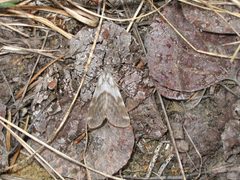
Medium-sized tiger moth with forewing length of approximately 15.5 mm in males and 14.3 mm in females. present in wing size.
Habitat
black spruce bogs and adjacent open pine uplands. Occupies peatland with characteristic vegetation including black spruce and associated wetland flora.
Distribution
to Canada. Documented from central to northern Alberta, Saskatchewan, Manitoba, and Yukon. The occupies a longitudinal range from central Alberta eastward to Manitoba, with northern extensions into Yukon.
Host Associations
- Salix - likely plantinferred from peatland association; larval feeding not confirmed
- Ericaceae - likely plantinferred from peatland association; larval feeding not confirmed
Ecological Role
Member of peatland . Potential herbivore in early life stages, though specific ecological functions remain undocumented.
Similar Taxa
- Other Dodia speciescongeneric tiger moths in the same , requiring detailed morphological examination for separation
More Details
Taxonomic history
Described as a new by Macaulay and Schmidt in 2009, representing a relatively recent addition to the known Canadian fauna.
Research gaps
Larval , complete , and definitive plant relationships remain unknown and require further study.