
Virbia aurantiaca
Hübner, 1831
orange holomelina, Orange Virbia Moth
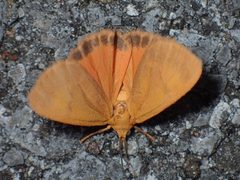
Virbia aurantiaca is a small in the Erebidae, commonly known as the orange holomelina or Orange Virbia Moth. It is recognized by its bright orange coloration and relatively small size, with forewings measuring approximately 10 mm in males and 9.7 mm in females. The has a broad distribution across North America, ranging from southern Canada through the eastern and central United States to Mexico. Larvae have been successfully reared on dandelion (Taraxacum) and plantain (Plantago) species.


Pronunciation
How to pronounce Virbia aurantiaca: //ˈvɪr.bi.ə ɔːˌræn.tiˈeɪ.kə//
These audio files are automatically generated. While they are not always 100% accurate, they are a good starting point.
Identification
Distinguished from other Virbia by its uniform bright orange coloration without contrasting dark markings or patterns present in such as V. laeta or V. rubicundaria. The small size and lack of wing patterning separate it from most other orange-colored in the region.
Images
Appearance
Small with bright orange forewings and body. Forewing length approximately 10 mm in males and 9.7 mm in females. The uniform orange coloration is distinctive within the .
Distribution
North America: southern Canada (Manitoba, Nova Scotia, Alberta, Saskatchewan, Vermont-US), eastern and central United States (Maine to Florida, west to Texas, Oklahoma, Kansas, North Dakota, South Dakota, Mississippi, Missouri, Tennessee, Louisiana), and south to Cordoba, Mexico.
Diet
Larvae have been reared on dandelion (Taraxacum) and plantain (Plantago) . feeding habits not documented.
Host Associations
- Taraxacum - larval food plantreared in captivity
- Plantago - larval food plantreared in captivity
Similar Taxa
- Virbia laetaSimilar size and but has contrasting dark markings on wings; V. aurantiaca lacks such patterning.
- Virbia rubicundariaOverlapping range but typically shows more reddish coloration and wing pattern elements absent in V. aurantiaca.