
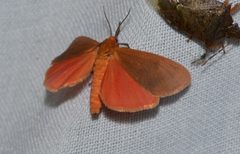
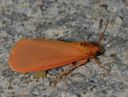
Virbia rubicundaria
(Hübner, 1831)
ruddy holomelina, black-banded holomelina, least holomelina
Pronunciation
How to pronounce Virbia rubicundaria: //ˈvɪr.bi.ə ˌruː.bɪˈkʌn.də.ri.ə//
These audio files are automatically generated. While they are not always 100% accurate, they are a good starting point.
Identification
Distinguished from other Virbia by its small size—forewing length under 9 mm makes it one of the smallest in the . The 'black-banded holomelina' suggests a dark transverse band on the wings, though this requires verification. Geographic range along the Gulf Coast may help separate it from similar species with more northern or inland distributions.
Images
Appearance
Small with forewing length approximately 8.9 mm in males and 8.7 mm in females. The specific wing coloration and pattern details are not documented in available sources.
Distribution
Southeastern United States: Georgia, Florida, and along the Gulf Coast to eastern Texas.
Seasonality
are on wing year-round with multiple per year.
Diet
Larvae have been reared on dandelion (Taraxacum) and Lactuca floridana (Florida lettuce). feeding habits are not documented.
Host Associations
- Taraxacum - larval food plantdandelion
- Lactuca floridana - larval food plantFlorida lettuce
Life Cycle
Multiple per year. Specific details of , larval, and pupal stages are not documented.
Similar Taxa
- Other Virbia speciesV. rubicundaria is distinguished by its notably smaller size; most are larger with forewing lengths exceeding 9 mm.
More Details
Basionym
Originally described as Crocota rubicundaria by Hübner in 1831 before transfer to Virbia.