
Apantesis ornata
(Packard, 1864)
Ornate Tiger Moth, Achaia Moth
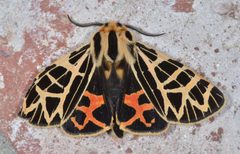
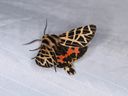
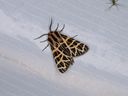
Apantesis ornata is a tiger moth in the Erebidae, originally described by Packard in 1864 under the name Callarctia ornata. The was long classified in the Grammia before being transferred to Apantesis in a 2016 revision that consolidated several related genera. It occurs across western North America from southern British Columbia to southern California and eastward to the Rocky Mountain states. are active during summer months and are attracted to light. The species exhibits the bright warning coloration typical of tiger moths, though specific details of its remain incompletely documented.
Pronunciation
How to pronounce Apantesis ornata: /æˈpæn.tə.sɪs ɔrˈnɑː.tə/
These audio files are automatically generated. While they are not always 100% accurate, they are a good starting point.
Identification
Apantesis ornata can be distinguished from other Apantesis by its wing pattern featuring bold contrasting markings. The species was formerly placed in Grammia, and specimens may still be encountered under that name in older collections and literature. Within the Apantesis, identification to species requires examination of wing pattern details and genitalia. The species is larger than many related tiger moths, with a wingspan that places it among the more conspicuous members of the genus. Distinguishing A. ornata from other ornate tiger moths in the same region, such as A. phalerata and A. carlotta, requires careful comparison of forewing and hindwing pattern elements, particularly the arrangement of pale spots and bands.
Images
Habitat
Occurs in a wide range of across its western North American range, including open woodland, forest edges, meadows, and riparian corridors. The shows flexibility in habitat use, being documented from low-elevation coastal areas to montane zones. Specific microhabitat preferences for resting, mating, or oviposition have not been detailed in published sources.
Distribution
Western North America from southern British Columbia through the Pacific Northwest (Washington, Oregon) to southern California. Eastern range limits include northern Utah, western Wyoming, and western Montana. The distribution corresponds broadly to the Pacific coastal and intermountain west, with records concentrated in areas with suitable summer moisture and diverse herbaceous vegetation.
Seasonality
are active during summer months, with period typically June through August depending on elevation and latitude. The is attracted to ultraviolet and mercury vapor lights during nighttime hours. Specific phenological details regarding timing and flight duration within the season have not been published.
Behavior
are and readily attracted to artificial light sources. Like other tiger moths, they likely engage in ultrasonic clicking as an anti-bat defense, though this has not been specifically documented for A. ornata. Mating and specific activity patterns remain undescribed in available literature.
Similar Taxa
- Apantesis phalerataOverlapping range in western North America with similar wing patterns; requires examination of spotting arrangement and genitalia for reliable separation
- Apantesis carlottaSympatric in parts of the Pacific Northwest and California; similar size and general appearance, distinguished by details of forewing maculation
- Grammia species (now Apantesis)Formerly classified together; many museum specimens and older literature use Grammia, requiring taxonomic updating for accurate identification
More Details
Taxonomic History
This has undergone multiple generic reassignments since its original description. Packard described it as Callarctia ornata in 1864. It was later transferred to Grammia, where it remained for over a century and is still frequently encountered under that name. A 2016 phylogenetic revision (Schmidt 2016) consolidated Grammia, Holarctia, and Notarctia into an expanded Apantesis, moving this species to its current combination. This revision has been widely adopted but not universally implemented in all databases and field guides.
Sources and further reading
- BugGuide
- Wikipedia
- iNaturalist taxon
- NCBI Taxonomy
- Catalogue of Life
- Bug Eric: Ichneumon Wasp: Ceratogastra ornata
- A flower visiting jewel beetle that is not an Acmaeodera | Beetles In The Bush
- Chrysomelidae | Beetles In The Bush | Page 5
- Bug Eric: National Moth Week 2021 Review
- Bug Eric: Remembering National Moth Week 2018
- Spring beetles on Coreopsis flowers | Beetles In The Bush