
Apantesis nais
Drury, 1773
Nais tiger moth
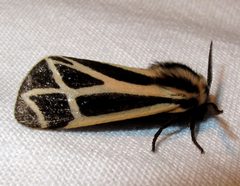
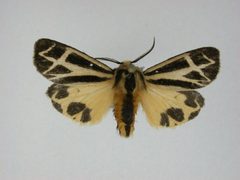
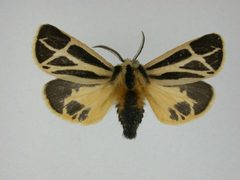
Apantesis nais, commonly known as the Nais tiger moth, is a of tiger moth in the Erebidae. First described by Dru Drury in 1773, this medium-sized is distinguished by its striking black-and-cream forewing pattern and variable reddish or yellow hindwings with bold black spotting. The species exhibits in wing pattern, with males displaying more extensive pale markings than females. It is widely distributed across eastern and central North America.
Pronunciation
How to pronounce Apantesis nais: //əˈpæn.tɪ.sɪs ˈneɪs//
These audio files are automatically generated. While they are not always 100% accurate, they are a good starting point.
Identification
Males can be distinguished from females by their more extensive cream-colored lines on the forewings. The combination of black forewings with cream markings and reddish or yellow hindwings with black spots separates this from many other tiger moths. The broad black subterminal bands on female hindwings are a key diagnostic feature. Similar species in the Apantesis may require examination of genitalia or detailed pattern comparison for reliable identification.
Images
Appearance
Wingspan 30–42 mm. Forewings predominantly black with cream-colored costal border and pale lines extending from the base in males; females have reduced pale forewing markings. Hindwings variable in color, typically reddish or yellow, with a row of large black spots in the area. Females have broad black bands in the subterminal area of the hindwings.
Habitat
Woodlands and forested . The is associated with wooded environments that provide plants for larval development.
Distribution
Eastern and central North America: from Quebec and Maine south to Florida, west to Texas and South Dakota. Also recorded in Ohio.
Seasonality
are active from April to October.
Diet
Larvae feed on a wide range of herbaceous and woody plants including grasses, violets (Viola spp.), plantain (Plantago spp.), and clover (Trifolium spp.). feeding habits are not documented in available sources.
Host Associations
- Viola - larval food plantviolets
- Plantago - larval food plantplantain
- Trifolium - larval food plantclover
Life Cycle
Complete with , larva, pupa, and stages. Specific details of duration and stage are not documented in available sources.
Behavior
are and attracted to light. Larvae are feeders on low-growing herbaceous vegetation.
Ecological Role
Larval herbivore; contributes to nutrient cycling in woodland . may serve as when nectaring, though this has not been documented.
Human Relevance
Occasionally encountered by naturalists and enthusiasts during blacklighting events. No significant economic impact documented.
Similar Taxa
- Apantesis phalerataSimilar tiger moth with black and pale forewing pattern; requires close examination of wing pattern details for separation
- Apantesis vittataAnother member of the same with comparable size and general appearance; hindwing pattern differs
- Grammia speciesFormerly placed in the same ; share tiger moth coloration and pattern but differ in specific wing markings
More Details
Taxonomic History
This was originally described as Spilosoma nais by Dru Drury in 1773 and later transferred to the Apantesis. The genus Apantesis has undergone taxonomic revision, with some species formerly placed in Grammia.
Sexual Dimorphism
The pronounced difference between male and female wing patterns is notable and should be considered when identifying specimens.
Sources and further reading
- BugGuide
- Wikipedia
- GBIF taxonomy match
- iNaturalist taxon
- NCBI Taxonomy
- Catalogue of Life
- Bug Eric: National Moth Week 2021 Review
- Bug Eric: Remembering National Moth Week 2018
- Sphingidae | Beetles In The Bush | Page 2
- Bug Eric: October 2018
- The Moth and Me | Beetles In The Bush
- Saturniidae | Beetles In The Bush | Page 2