
Stigmella lapponica
(Wocke, 1862) Fletcher et al., 1945
Stigmella lapponica is a minute in the Nepticulidae, described by Maximilian Ferdinand Wocke in 1862 from northern Norway. The is notable for its leaf-mining larvae that feed exclusively on birch leaves, creating distinctive slender galleries. are active in May with a single per year, though partial second have been suggested. The moth occurs across the Holarctic region, including Europe, Asia, and North America.
Pronunciation
How to pronounce Stigmella lapponica: /stɪɡˈmɛlə læpˈpɒnɪkə/
These audio files are automatically generated. While they are not always 100% accurate, they are a good starting point.
Identification
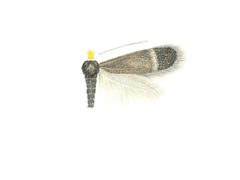
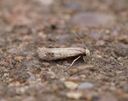
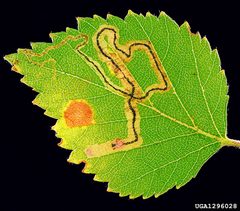
Distinguished from similar Stigmella by the combination of: ferruginous-orange to blackish (not entirely black); oblique whitish-ochreous forewing fascia at 2/3; and the larval mine on birch—a slender corridor that hardly widens, with first quarter filled with cloudy green and remainder with black frass in broad clear margins. Larva greenish-white with darker green gut; head with some brown, darker than in Stigmella confusella. The gallery is long, angular, follows with sudden direction changes, and can cross veins and the midrib.
Images
Habitat
Associated with birch woodland and scrub. Larvae develop on birch leaves including shrubby birch (Betula humilis), dwarf birch (Betula nana), silver birch (Betula pendula), and downy birch (Betula pubescens) including carpatica. are laid on the underside of birch leaves, usually beside a rib.
Distribution
Holarctic distribution: most of Europe (except Balkan Peninsula and Mediterranean islands), east through the Palearctic to eastern Asia, and in North America (recorded from British Columbia, Canada). The type locality is Bossekop, Finnmark, Norway.
Seasonality
on wing in May. One per year (), though larvae have been found in October suggesting possible partial second in some regions. Larvae feed in June and July.
Diet
Larval stage feeds as a inside birch (Betula) leaves. Specific recorded include Betula humilis, Betula nana, Betula pendula, and Betula pubescens (including B. p. carpatica). do not feed; mouthparts reduced or non-functional as typical for many Nepticulidae.
Host Associations
- Betula humilis - larval shrubby birch
- Betula nana - larval dwarf birch
- Betula pendula - larval silver birch
- Betula pubescens - larval downy birch, including carpatica
Life Cycle
: laid on underside of birch leaf, usually beside a rib. Larva: greenish-white with darker green gut, mines birch leaves in slender corridor; feeds June–July (with October records suggesting possible partial second ). Pupa: cocoon spun below surface, deep reddish or purplish brown. : emerges in May. time: one year (), with possible partial second brood.
Behavior
Larvae are leaf miners, feeding internally within birch leaf tissue. The mine begins as a slender corridor with cloudy green , then continues with black frass and broad clear margins. The gallery is characteristically angular, following leaf with sudden direction changes and capable of crossing veins and the midrib. are and , typical for the .
Ecological Role
As a on birch, the contributes to nutrient cycling through leaf tissue processing. It serves as prey for and associated with leaf-mining . The species is part of the guild of insects that process birch foliage in and temperate woodland .
Human Relevance
No direct economic importance. Occasionally studied as part of birch-associated insect . The name honors the Lapland region of northern Norway where the was collected, reflecting historical entomological exploration of northern Europe.
Similar Taxa
- Stigmella confusellaSimilar larval appearance and mine form; distinguished by larval coloration (S. lapponica has darker brown on head) and head color (ferruginous-orange to blackish in S. lapponica versus different pattern in S. confusella)
- Other Stigmella species on birchMany Stigmella mine birch leaves; S. lapponica is distinguished by the combination of forewing pattern (oblique whitish fascia at 2/3), coloration, and larval mine characteristics (angular gallery with specific pattern)
More Details
Etymology
The lapponica refers to Lapponicus (Lappish), alluding to the type locality at Bossekop, Finnmark, in northern Norway. The name Stigmella derives from Latin 'stigma' (small dot or brand), referring to the conspicuous or occasionally metallic fascia on the forewing of many , or possibly the small size of these .
Taxonomic history
Originally described as Nepticula lapponica by Wocke in 1862, later transferred to Stigmella. The was among the early descriptions of the diverse northern European microlepidoptera fauna.