
Acalyptris
Meyrick, 1921
Species Guides
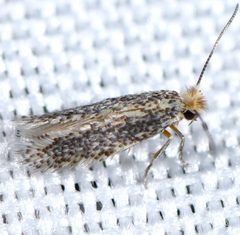
2Acalyptris is a of minute in the Nepticulidae, established by Meyrick in 1921. It represents the second largest genus of Nepticulidae in the Americas and contains approximately 100 described distributed across six continents. The genus is characterized by leaf-mining larvae that create distinctive mines in plant foliage. Species are organized into multiple species groups based on and host associations, with nine revised species groups recognized in the American fauna.
Pronunciation
How to pronounce Acalyptris: /əˈkalɪptrɪs/
These audio files are automatically generated. While they are not always 100% accurate, they are a good starting point.
Identification
Identification to requires dissection and examination of genitalia. The is divided into species groups based on and larval associations. In Europe and the Mediterranean, the A. platani group (leafminers on Anacardiaceae, Platanaceae, Loranthaceae) and A. staticis group (feeders on Plumbaginaceae) can be distinguished by host plant and larval morphology. CO1 barcode sequences are available for some species and have been used to assess phylogenetic relationships. Larval leaf mines and pupal characters provide additional diagnostic information.
Images
Appearance
are minute with wingspans typically under 5 mm, consistent with the microlepidopteran Nepticulidae. Wing venation and genitalic structures are primary diagnostic features used to distinguish . Larvae are legless, -like leaf miners with reduced capsules. Pupal often bear characteristic spine-like projections or other cuticular structures that aid species identification.
Habitat
Found in diverse terrestrial where plants occur, including temperate forests, Mediterranean scrub, tropical rainforests, and arid regions. Specific habitat associations are determined by host plant distribution. In the Americas, occur from western Amazonian rainforest and Andean elevations to Patagonian steppe and arid Yucatán Peninsula.
Distribution
distribution with described from North America, Central America, South America, Europe, Mediterranean region, Africa, and Asia. American fauna includes 56 described species ranging from the western Amazon and Andes of Ecuador, Peru, and Bolivia to Patagonian Argentina and Chile, plus the Yucatán Peninsula, Caribbean, Guatemala, Belize, and Pacific Mexico. European and Mediterranean species occur from Spain and Germany to Greece, Cyprus, Turkey, Algeria, and Tunisia.
Diet
Larvae are obligate leaf miners, feeding internally on leaf mesophyll. plant associations vary by group: Anacardiaceae, Platanaceae, and Loranthaceae for the A. platani group; Plumbaginaceae for the A. staticis group; Verbenaceae ( involucrata) for some Neotropical species. Host plants for many species remain unknown or unconfirmed.
Host Associations
- Anacardiaceae - larval A. platani group
- Platanaceae - larval A. platani group
- Loranthaceae - larval A. platani group
- Plumbaginaceae - larval A. staticis group; includes Limoniastrum and Limonium
- Verbenaceae - larval involucrata for A. caribbicus
- Pistacia - larval for A. pistaciae
- Malvaceae - larval Guazuma ulmifolia documented for related Stigmella in same
Life Cycle
Holometabolous development with leaf-mining larval stage. are deposited on plant leaves. Larvae feed internally, creating serpentine or blotch mines. Final instar larvae exit mines to pupate, often in soil or leaf litter. Pupal are frequently extruded from the site and can be found on leaf surfaces or nearby substrates. stages have been described for several ; larvae and pupae of A. lesbia differ markedly in from those of the A. platani group.
Behavior
are typically or . Larvae are sedentary leaf miners, feeding within plant tissues. Mining patterns vary by and host plant. Some species show host specificity at the or level.
Ecological Role
Larvae function as primary consumers, causing leaf damage to plants. Recorded include Braconidae and Eulophidae (Hymenoptera), indicating role in supporting parasitoid . Leaf mining activity may affect host plant physiology and productivity, though impacts are generally minor on healthy plants.
Human Relevance
Some have been studied for their potential use in , particularly those associated with plants. A. pistaciae and related species have been investigated for possible application against Pistacia species. The serves as a model group for studies of microlepidopteran diversity, plant relationships, and phylogeography. Leaf mines are occasionally noticed by horticulturists and naturalists.
Similar Taxa
- StigmellaAlso in Nepticulidae with leaf-mining larvae; distinguished by genitalic and wing venation characters; Stigmella is the largest in the and often shares and plants
- EctoedemiaNepticulid with similar minute and leaf-mining larvae; separated by genitalic and larval characters
- FomoriaPreviously recognized as distinct ; Fomoria miranda has been transferred to Acalyptris based on morphological analysis, indicating close relationship and historical taxonomic confusion
More Details
Taxonomic History
The was established by Edward Meyrick in 1921. Recent revisions have reorganized into morphological groups, with nine species groups now recognized for the American fauna. The phylogenetic relationships among these groups remain incompletely resolved; CO1 sequence data indicate that the A. platani and A. staticis groups are not closely related despite both being assigned to Acalyptris.
Research Significance
Acalyptris has become an important study system for understanding Nepticulidae diversity, particularly in the Neotropics where it represents the second largest in the . The group exhibits substantial undescribed diversity, with new continuing to be discovered and described from Central and South America.
Sources and further reading
- BugGuide
- Wikipedia
- GBIF taxonomy match
- iNaturalist taxon
- NCBI Taxonomy
- Catalogue of Life
- Acalyptris Meyrick: revision of the platani and staticis groups in Europe and the Mediterranean (Lepidoptera: Nepticulidae)
- Diagnostics and updated catalogue of Acalyptris Meyrick, the second largest genus of Nepticulidae (Lepidoptera) in the Americas
- Four new leaf-mining Acalyptris species from Guatemala and Belize, with new data on bionomics of Stigmella pruinosa (Lepidoptera: Nepticulidae)