
Phyllonorycter platani
(Staudinger, 1870)
London Midget, plane leaf miner
Phyllonorycter platani is a small leaf-mining in the Gracillariidae, commonly known as the London Midget or plane . The is notable for its association with Platanus (plane trees) as its larval , creating distinctive blotch mines on leaves. It has been introduced to North America and is considered an in some regions. The moth has a wingspan of 8–10 mm and produces two annually in parts of its range.
Pronunciation
How to pronounce Phyllonorycter platani: /ˌfɪləˈnɒrɪktər pləˈtɑːnaɪ/
These audio files are automatically generated. While they are not always 100% accurate, they are a good starting point.
Identification
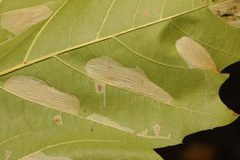
Distinguished from other Phyllonorycter by association with Platanus plants and specific mine . The blotch mines on plane tree leaves are characteristic: upper-surface or lower-surface mines with partially or completely eaten, creating translucent patches. require genitalia examination or for definitive species-level identification within the . In North America, distinguished from native Phyllonorycter species by host plant specificity and geographic origin.
Images
Appearance
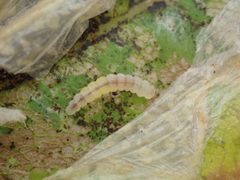
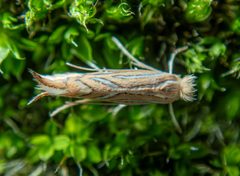
Small with wingspan of 8–10 mm. Forewings typically exhibit characteristic patterning of the Phyllonorycter, with white or cream ground color marked by dark brown or blackish fascia and striations. Hindwings narrow, grayish, with long fringes. Body slender, matching forewing coloration. , approximately half body length. Larva is a minute caterpillar adapted for leaf-mining habit.
Habitat
Urban and suburban environments, parks, avenues, and natural areas where Platanus occur. In Europe, commonly found in cities where plane trees are planted as street trees. In North America, established in California and expanding range. Prefers open, sunny conditions where trees grow.
Distribution
Native to Europe, the Near East, and the eastern Palearctic ecozone. Introduced to North America, with established in California, United States. Records from Spain (including Canary Islands), France (including Corsica), Greece (including Crete), Italy (including Sardinia and Sicily).
Seasonality
(two ) in parts of its range, flying from mid-June to November in Belgium and the Netherlands; periods may vary across distribution. Larval mining activity coincides with tree leaf availability.
Diet
Larvae feed exclusively on Platanus (plane trees), mining within leaf tissue. do not feed.
Host Associations
- Platanus - larval Larvae create blotch mines in leaves
Life Cycle
Complete with , larval, pupal, and stages. Larvae are leaf miners, feeding internally within Platanus leaf tissue. occurs within the mine or in a silken cocoon on the leaf surface. Two per year in temperate regions; stage not specified in available sources.
Behavior
Larvae construct blotch mines on plane tree leaves, feeding between upper and lower . Mining activity may reduce photosynthetic capacity of leaves. are and attracted to light. Limited information on adult ; likely capable of moderate distances given spread pattern.
Ecological Role
Herbivore on Platanus; leaf mining damage is generally minor and not considered economically significant. Serves as for diverse —72 parasitoid from seven Hymenoptera have been documented across its range, with 18 species recorded in Serbia alone. rates vary geographically (15–38% in Serbia, lower in some European ). The composition of parasitoid complexes has been used to infer possible North American origin of the species.
Human Relevance
Minor aesthetic concern in urban areas due to leaf mining on ornamental plane trees. Not considered a serious pest; damage is typically superficial. Subject of biosurveillance and monitoring in North America. Used as model system for studying - relationships and biological invasions.
Similar Taxa
- Other Phyllonorycter speciesNumerous exist; distinguished by plant association, mine , and genitalia structure
- Cameraria speciesAlso leaf-mining in Gracillariidae; create linear mines rather than blotches and typically on different plants
More Details
Parasitoid diversity
Among the most thoroughly documented - systems in Gracillariidae, with 72 parasitoid recorded globally. European parasitoid complexes lack narrow , suggesting relatively recent host-parasitoid evolutionary history.
Invasion history
Introduction to California represents significant range expansion; continues to spread in North America. Analysis of composition suggests possible North American origin, though this remains debated.
Sources and further reading
- BugGuide
- Wikipedia
- GBIF taxonomy match
- iNaturalist taxon
- NCBI Taxonomy
- Catalogue of Life
- Hymenoptera | Beetles In The Bush | Page 6
- Bug Eric: My Personal National Moth Week, 2017
- Bug Eric: September 2017
- Chrysomelidae | Beetles In The Bush | Page 3
- wasps | Beetles In The Bush | Page 4
- PARASITOIDS (HYMENOPTERA) OF PHYLLONORYCTER PLATANI (STAUDINGER, 1870) (LEPIDOPTERA, GRACILLARIIDAE)
- Parasitoids (Hymenoptera) of Phyllonorycter platani (Staudinger, 1870) (Lepidoptera, Gracillariidae)
- Parasitoids of Phyllonorycter platani (Staudinger) (Lepidoptera, Gracillariidae) in Serbia