
Homaledra
Busck, 1900
palm-leaf skeletonizer
Species Guides
5- Homaledra heptathalama(exclamation moth)
- Homaledra howardi
- Homaledra knudsoni
- Homaledra octagonella(Octagonal Casemaker Moth)
- Homaledra sabalella(Palm Leaf Skeletonizer Moth)
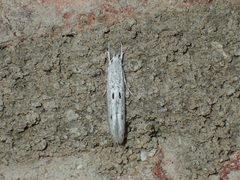
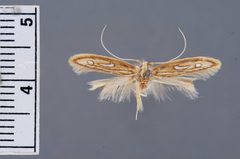
Homaledra is a of small in the Pterolonchidae, native to North and South America. The genus includes at least four , with H. sabalella and H. heptathalama known as pests of palms in the southeastern United States. Larvae are herbivores of palms, feeding colonially on frond undersides beneath protective silk cover.
Pronunciation
How to pronounce Homaledra: //hɒməˈlɛdrə//
These audio files are automatically generated. While they are not always 100% accurate, they are a good starting point.
Identification
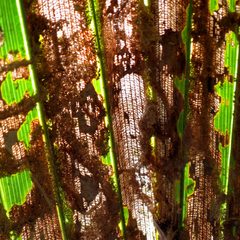
Larvae construct distinctive silken chambers on palm frond undersides, reinforced with , consisting of successively larger rectangular communicating rooms. are small ; specific diagnostic features for distinguishing Homaledra from related are not documented in available sources.
Images
Habitat
Floodplains, alluvial forests, moist beach , mesic forests, drier forests, and prairie habitats. Within forests, abundance is higher in dry habitats than wet habitats; open understory promotes compared to shrub understory. Associated with palms (Sabal minor and other palm ).
Distribution
North America: Alabama, Florida, Mississippi, South Carolina, Texas, Louisiana, Puerto Rico, Hispaniola, Cuba. South America: Peru, Brazil.
Seasonality
Five or more per year in the Florida panhandle to Louisiana region. stage present in late February. short-lived: males survive up to 4 days, females up to 20 days.
Diet
herbivore of native and introduced palm . Caterpillars feed on palm fronds, skeletonizing leaves from the underside.
Host Associations
- Sabal minor - larval dwarf palmetto; primary study in Louisiana
- native palm species - larval
- introduced palm species - larval
Life Cycle
Caterpillars feed colonially under dense protective silk cover on frond undersides. occurs beneath silk cover within silken tubes. Five or more per year in Florida panhandle to Louisiana region. stage present.
Behavior
Strong ability with well-connected local ; dispersal limitation is minor. Colonizes tall palmettos 2.5× more frequently than small palmettos. Colonial feeding under dense silk cover. Larvae construct elongate chambers with successively larger rectangular rooms as they grow.
Ecological Role
Herbivore and pest of various palm . attack the pupal stage. Distribution among plants determined primarily by local environmental conditions rather than spatial structure or isolation.
Human Relevance
At least two (H. sabalella and H. heptathalama) are recognized pests of palms in Florida. Considered a pest of various palm species in horticultural and natural settings.
Similar Taxa
- BatrachedraFormerly classified together in Batrachedrinae; distinguished by current placement in Pterolonchidae versus Batrachedridae
- Coleophoridae (case-bearers)Formerly included in this ; Homaledra larvae lack the portable cases characteristic of Coleophoridae, instead constructing fixed silken chambers on plants
More Details
Taxonomic history
Originally described by Busck in 1900. Included in Coleophoridae by Hodges (1983), then moved to Batrachedrinae of Batrachedridae (1999). Reclassified to Pterolonchidae following cladistic analysis by Heikkilä et al. (2014). Two South American transferred from Pammeces by Hodges in 1997.