
Batrachedra
Herrich-Schäffer, 1853
Species Guides
5- Batrachedra busiris
- Batrachedra concitata
- Batrachedra enormis(Large Batrachedra Moth)
- Batrachedra pinicolella(Pine Cosmet)
- Batrachedra striolata
Batrachedra is the largest in the Batrachedridae, containing approximately 114 as of 2018. The genus has a distribution with particularly high diversity in the Indomalayan realm. The name derives from Greek 'batrachos' (frog) and 'edra' (seat), referring to the frog-like resting posture of . Early stages remain unknown for most species.
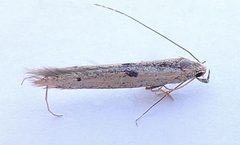
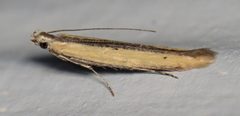
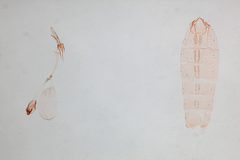
Pronunciation
How to pronounce Batrachedra: /bætrəˈkɛdrə/
These audio files are automatically generated. While they are not always 100% accurate, they are a good starting point.
Identification
The frog-like resting posture of is a distinctive behavioral trait associated with this . -level identification requires examination of genitalia and molecular markers; cryptic diversity has been documented in European species previously treated as single .
Images
Appearance
rest in a characteristic frog-like posture, with the body hunched and wings held close. This posture is the source of the name. Specific morphological descriptions vary by ; no genus-level diagnostic features beyond resting posture are established in available sources.
Habitat
varies widely across . Documented associations include coniferous forests (Picea, Pinus), date palm plantations, coconut plantations, and various tropical and temperate environments. No single habitat characterizes the .
Distribution
distribution with representatives on all continents. High biodiversity in the Indomalayan realm. Only three occur in Europe. Some species have been introduced to new regions (e.g., B. pinicolella introduced to Canada).
Diet
Caterpillars use diverse plants across . Documented hosts include: conifers (Picea abies, Pinus sylvestris), date palms (Phoenix dactylifera), coconut palms (Cocos nucifera), palms (various), pineapple, Agave, Smilax china, Cyperaceae, Juncaceae, Salix, and Populus. Some species are leaf miners; others feed on fruits or inflorescences.
Host Associations
- Picea abies - larval B. pinicolella
- Pinus sylvestris - larval B. confusella
- Phoenix dactylifera - larval B. amydraula, major pest
- Cocos nucifera - larval B. arenosella, B. nuciferae
- Roystonea oleracea - larval B. nuciferae
- Ananas comosus - larval pest
- Agave - larval pest
- Smilax china - larval fruit feeder
- Cyperaceae - larval one
- Juncaceae - larval one
- Salix - larval one
- Populus - larval B. praeangusta
Life Cycle
details are -specific and unknown for most. B. amydraula has three per year in Oman, with larvae appearing in April, in March, and in April. A dormancy period from August to March has been observed in this species, with larvae resting between bases of terminal fronds.
Behavior
adopt a distinctive frog-like resting posture. Some are active pests of cultivated plants. Larval varies: some are leaf miners in conifer needles, others feed on fruits or inflorescences.
Ecological Role
Several are significant agricultural pests, particularly of date palms and coconuts. Larvae function as herbivores, with some species causing substantial crop losses. Natural enemies include (Goniozus omanensis, Chelonus sp., Trichogramma spp.).
Human Relevance
Multiple are economically important pests. Batrachedra amydraula (lesser date ) causes over 50% crop loss in date palms and is subject to intensive chemical and efforts. Other pest species attack pineapple, Agave, and coconut. Some species are targets of biological control programs using releases.
Similar Taxa
- Other GelechioideaBatrachedridae was formerly placed in Cosmopterigidae or as a thereof; molecular and morphological studies support -level distinction. Batrachedra can be distinguished by the combination of frog-like resting posture and specific wing venation patterns.
More Details
Taxonomic history
The was described by Herrich-Schäffer in 1853. The Batrachedridae has undergone significant taxonomic revision, previously treated as Batrachedrinae within Cosmopterigidae or Elachistidae before elevation to family rank based on molecular and morphological evidence.
Cryptic diversity
efforts in Europe revealed that B. pinicolella comprised two genetically distinct , leading to description of B. confusella sp. nov. This suggests similar cryptic diversity may exist in other regions.
Knowledge gaps
Early stages (, larvae, pupae) remain unknown for the majority of . associations are documented for only a small fraction of the approximately 114 described species.
Sources and further reading
- BugGuide
- Wikipedia
- GBIF taxonomy match
- iNaturalist taxon
- NCBI Taxonomy
- Catalogue of Life
- Chemical control of the Lesser Date Moth, Batrachedra amydraula (Lepidoptera: Batrachedridae)
- Biological Control of Lesser Date Moth (Batrachedra. Amydraula/ mayrick) using the local parasitoid Goniozus omanensis المكافحة الحيوية لآفة الحميرة (Batrachedra. Amydraula/ mayrick) باستخدام الطفيل المحلي طفيل الجينوزس Goniozus omanensis
- STUDIES ON CHELONUS SP. THE PARASITE OF THE COCONUT MOTH BATRACHEDRA ARENOSELLA WALKER
- Biology, morphology and taxonomy of Lesser Date Moth, Batrachedra amydraula (Lepidoptera: Batrachedridae) under two different temperatures
- Integrative taxonomy reveals overlooked cryptic diversity in the conifer feeding Batrachedra pinicolella (Zeller, 1839) (Lepidoptera, Batrachedridae)
- Effectiveness of four release doses of two parasitoids species, <i>Trichogramma</i> (Hymenoptera: Trichogrammatidae) in some biological aspects of the lesser date moth <i>Batrachedra amydraula</i> Meyricke (Cosmopteridae: Batrachedridae) on date palm trees in Basrah /Iraq. Učinkovitost štirih velikosti izpustitve parazitoidnih vrst iz rodu, <i>Trichogramma</i> (Hymenoptera: Trichogrammatidae) na nekatere biološke parametre manjšega dateljevega molja <i>Batrachedra amydraula</i> Meyricke, 1916 (Cosmopteridae: Batrachedridae) na palmah v Basri, Irak
- Evaluation of Different Insecticides Against Lesser Date Moth, Batrachedra amydraula Meyrick, 1916 (Lepidoptera: Batrachedridae) under Field Conditions
- Batrachedra nuciferae, an Inflorescence-Feeding Moth Associated with Coconut,Cocos nucifera, and Palmiste,Roystonea oleracea, in Trinidad, West Indies
- The genome sequence of the Poplar Cosmet moth, Batrachedra praeangusta (Haworth, 1828).