
Pterolonchidae
Meyrick, 1918
Genus Guides
2- Coelopoeta
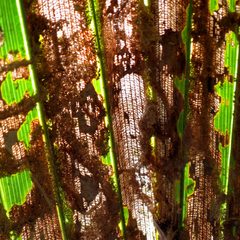
- Homaledra(palm-leaf skeletonizer)
is a small of minute in the superfamily Gelechioidea, comprising approximately 19 across seven . The family has undergone substantial taxonomic revision, with genera reassigned from multiple other families based on cladistic analysis. Species are distributed across every continent except Australia and Antarctica, with notable concentrations in the Mediterranean region, western North America, and southern Africa. Several species have significant ecological and economic importance, including one used as a agent for knapweeds and another that is a major agricultural pest of cereal crops.

Pronunciation
How to pronounce Pterolonchidae: //ˌtɛrəˈlɒŋkɪdiː//
These audio files are automatically generated. While they are not always 100% accurate, they are a good starting point.
Identification
Distinguished from other Gelechioidea by a combination of genitalic characters and larval . can be separated from the closely related Coleophoridae by morphological features established in phylogenetic analyses. Within the , are distinguished by larval feeding habits: Coelopoetinae (leaf-miners in Boraginaceae), Pterolonchinae (root-borers in Asteraceae), Syringopainae (grass stem borers), and unplaced with specialized feeding modes (palm leaf undersides, Restionaceae miners).
Images
Appearance
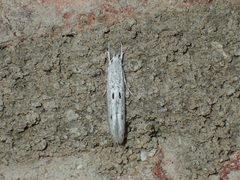
Very small with reduced wing venation and characteristic genitalia structures that distinguish them from related gelechioid . Members of the Coelopoetinae exhibit distinctive male genitalia that separates them into two distinct groups. of Pterolonche species are and attracted to light. Larval forms are concealed feeders: root-borers, leaf-miners, or shelter-builders depending on .
Habitat
varies substantially by and . Pterolonche occupy disturbed sites with knapweed stands on sandy or stony soils in Mediterranean climates. Coelopoeta species inhabit low vegetation in western North American habitats from California to the Yukon, with entire above ground. Houdinia is restricted to Restionaceae wetlands in northern New Zealand. Homaledra occurs on palms in the Americas. Anathyrsa and Plexippica occupy southern African habitats.
Distribution
Native to every continent except Australia and Antarctica. Pterolonche is circum-Mediterranean: Portugal, Spain, France, Italy, Malta, Hungary, Romania, former Yugoslavia, Crete, Cyprus, Anatolia, Iraq, Egypt, Tunisia, Algeria, Morocco. Anathyrsa is to southern South Africa. Plexippica occurs in southern Africa. Coelopoeta is restricted to western North America (California to Yukon). Syringopais temperatella occurs on Cyprus, in Greece, and the Near East from Israel and Turkey to western Iran. Homaledra has two in South America and two in North America. Houdinia is endemic to northern North Island, New Zealand.
Seasonality
Pterolonche inspersa emerge July–August with peak activity mid-August. Syringopais temperatella adults are active day and night in May in Turkey, with laid in summer and caterpillars emerging winter to early spring. Coelopoeta with known biologies complete above ground in low vegetation. Specific seasonality data for remaining is not documented.
Diet
Highly specialized feeding by : Pterolonche larvae are root-borers in Asteraceae (Centaurea diffusa, C. maculosa). Coelopoeta larvae are leaf-miners in Boraginaceae, with some inducing gall-like deformations. Homaledra feeds on undersides of palm leaves. Houdinia mines in Restionaceae. Syringopais mines in grasses. Anathyrsa and Plexippica is undocumented.
Host Associations
- Centaurea diffusa - larval primary for Pterolonche inspersa; root-boring
- Centaurea maculosa - larval primary for Pterolonche inspersa; root-boring
- Boraginaceae - larval leaf-mining for Coelopoeta
- Arecaceae (palms) - larval Homaledra feeds on leaf undersides
- Restionaceae - larval Houdinia mines in stems
- Poaceae (grasses) - larval Syringopais temperatella mines in grass stems
- Triticum aestivum (wheat) - larval agricultural pest for Syringopais temperatella
- Hordeum vulgare (barley) - larval agricultural pest for Syringopais temperatella
Life Cycle
Pterolonche inspersa: one per year; larvae feed in roots for approximately 11 months (August–September to following July–August); pupal stage lasts ~15 days; emerge July–August. Syringopais temperatella: laid in summer; caterpillars emerge winter to early spring; adults active May. Coelopoeta: entire spent above ground in low vegetation; specific timing undocumented. Other : life cycle details unknown.
Behavior
Pterolonche and Anathyrsa are ; both sexes attracted to lamps. Pterolonche inspersa mate within 24 hours of . Females oviposit on rosette leaves singly or in small groups of 5–6 firmly attached to foliage. Homaledra larvae construct elaborate silk feeding chambers under which they hide while feeding. Syringopais temperatella adults are active both diurnally and nocturnally.
Ecological Role
Pterolonche inspersa acts as a agent regulating knapweed (Centaurea diffusa and C. maculosa) in western North America. The has established and spread from initial release sites in Colorado, Montana, and Oregon to Idaho and British Columbia. Coelopoeta species may be threatened by intensifying forest fire regimes in southwestern North America due to their obligate above-ground in low vegetation.
Human Relevance
Pterolonche inspersa was introduced to North America as a agent for diffuse and spotted knapweeds in the 1980s; establishment was initially uncertain but the has since spread. Syringopais temperatella is a major agricultural pest of wheat and barley in Cyprus, Jordan, Iraq, and Iran, causing significant crop damage. No other species have documented economic or cultural significance.
Similar Taxa
- ColeophoridaeHistorically confused with ; Hodges (1999) classified Pterolonchidae as Pterolonchinae within Coleophoridae, but subsequent cladistic analysis restored status. Distinguished by morphological and molecular characters.
- Batrachedridae Homaledra and Houdinia were transferred from Batrachedridae to in 2014 based on cladistic analysis by Heikkilä et al.; previously considered batrachedrid based on alone.
- ElachistidaeCoelopoeta was historically placed in Elachistidae before transfer to as Coelopoetinae; distinguished by male genitalia and barcode data.
- DeoclonidaeSyringopais was transferred from Deoclonidae to as Syringopainae based on phylogenetic analysis; previously classified separately due to morphological convergence.
More Details
Taxonomic instability
The has experienced substantial taxonomic revision. Validity of the family name was established by Fletcher (1929) after Meyrick's (1918) . Classification shifted from independent family (Vives 1987) to of Coleophoridae (Hodges 1999) back to family status (Heikkilä et al. 2014). The 2014 cladistic analysis restructured internal classification, creating three subfamilies and leaving two unplaced.
Conservation concern
Some Coelopoeta in southwestern North America are potentially threatened by increasingly intense and frequent forest fires, as their entire occur above ground in low vegetation. This represents a documented vulnerability for a gelechioid group.
Sources and further reading
- BugGuide
- Wikipedia
- GBIF taxonomy match
- iNaturalist taxon
- NCBI Taxonomy
- Catalogue of Life
- Biology ofPterolonche inspersa (Lep.: Pterolonchidae), a biological control agent forCentaurea diffusa andC. maculosa in the United States
- A review of Coelopoetinae (Lepidoptera, Gelechioidea, Pterolonchidae), a moth subfamily confined to western North America, with descriptions of seven new species
- Host specificity ofPterolonche inspersa [Lep.: Pterolonchidae] and its potential as a biological control agent forCentaurea diffusa, diffuse knapweed, andC. Maculosa, spotted knapweed