
Homaledra sabalella
(Chambers, 1880)
Palm Leaf Skeletonizer Moth
Homaledra sabalella, commonly known as the palm leaf skeletonizer , is a small moth in the Pterolonchidae. The has undergone multiple taxonomic reclassifications, moving from Coleophoridae to Batrachedridae before its current placement. It is found in the southeastern United States and Caribbean islands. The larvae are specialized feeders on palm fronds.

Pronunciation
How to pronounce Homaledra sabalella: /hɒməˈliːdrə sæbəˈlɛlə/
These audio files are automatically generated. While they are not always 100% accurate, they are a good starting point.
Identification
The combination of small size (18 mm wingspan), association with palm , and geographic distribution in the southeastern United States and Caribbean distinguishes this . Definitive identification requires examination of genitalia or molecular analysis due to the lack of distinctive external markings described in available sources.
Images
Appearance
Small with a wingspan of approximately 18 mm.
Habitat
Associated with palm-growing regions. Larvae inhabit palm fronds where they feed and develop.
Distribution
Southeastern United States (Alabama, Florida, Mississippi, South Carolina, Texas) and Caribbean islands (Puerto Rico, Hispaniola, Cuba).
Seasonality
are active year-round in suitable climates.
Diet
Larvae feed on palm fronds of Sabal palmetto, Sabal causiarum, and Cocos nucifera. feeding habits are not documented.
Host Associations
- Sabal palmetto - larval food plant
- Sabal causiarum - larval food plant
- Cocos nucifera - larval food plant
Life Cycle
Complete with larval development occurring on palm fronds. Specific details of site and number of per year are not documented.
Behavior
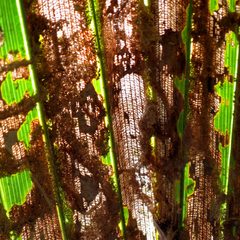
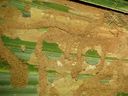
Larvae skeletonize palm fronds by feeding on the tissue between leaf , leaving a characteristic lace-like pattern.
Ecological Role
Herbivore specializing on palms; may contribute to nutrient cycling through frond damage. Specific ecological impacts are not quantified.
Human Relevance
Considered a minor pest of ornamental and agricultural palms due to larval feeding damage. Not known to cause severe economic damage.
Similar Taxa
- Other Homaledra speciesCongeneric may overlap in distribution and use; identification requires detailed morphological or genetic examination.
- Other palm-feeding LepidopteraSeveral contain palm ; larval damage patterns and specificity help distinguish this .
More Details
Taxonomic History
This has been reclassified multiple times: originally described as Laverna sabalella (1880), placed in Coleophoridae (1983), moved to Batrachedridae (1999), and finally to Pterolonchidae (2014) based on cladistic analysis by Heikkilä et al.