
Coleotechnites thujaella
(Kearfott, 1903)
brown arborvitae leafminer, brown cedar leafminer
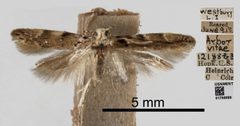
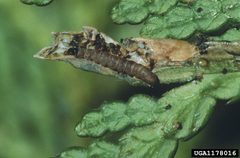
Coleotechnites thujaella is a small gelechiid commonly known as the brown arborvitae leafminer or brown cedar leafminer. It occurs in northeastern North America, where its larvae feed internally on Thuja foliage. The is recognized by its distinctive wing pattern of black triangular costal patches and paired black dots on cream-white forewings. have a wingspan of 9–10 mm and are active in a single .
Pronunciation
How to pronounce Coleotechnites thujaella: //ˌkɒli.oʊˈtɛknɪtiːz ˌθjuːdʒiˈɛlə//
These audio files are automatically generated. While they are not always 100% accurate, they are a good starting point.
Identification
Distinguished from other Coleotechnites by the specific arrangement of six black dots in three vertical pairs on the forewing, combined with three costal black patches and the distinctive ocellus. The pattern of black raised bordered by white scales is diagnostic. Similar in the may share general gelechiid but differ in precise number, arrangement, and shape of dark markings; C. thujaella's triangular costal patches and paired dot arrangement are unique.
Images
Appearance
Forewings cream white with three outwardly oblique, roughly triangular black costal patches edged outwardly with whitish ; inner patch largest, extending from base nearly to dorsum, middle and outer patches smaller and reaching only to line. Each patch has denser cluster of black raised scales at lower apex forming distinct black dot. Three additional small black dots below patches close to dorsum, and sixth black dot between basal and middle patches close to , all formed of black raised scales bordered by one or two pure white scales, arranged in three vertical pairs. Outer patch bordered by white line curving obliquely outward to middle of wing then inward to dorsum; beyond this, costa with patch overlaid with dark brown scales, then wide blackish-brown band on outer margin with paler streak at extreme edge. Six small black dots of raised scales with white borders on area: three on costa before apex, one at apex, one on outer margin near apex, one near outer angle; apical spot narrowly ringed with ground colour bordered by darker scales condensed into fine semicircular line on extreme apical margin, forming distinct apical ocellus. Hindwings light grey. Wingspan 9–10 mm.
Distribution
Northeastern United States and Canada. GBIF records confirm presence in Canada (CA) and United States (US).
Seasonality
One per year; specific period not documented in sources.
Host Associations
- Thuja - larval references arborvitae and cedar, both Thuja
Life Cycle
One per year (). Larval stage mines leaves of Thuja; specific details of , pupal stage, and not documented.
Ecological Role
Larval leaf mining causes damage to Thuja foliage; specific ecological impacts not quantified.
Human Relevance
Recognized as a pest of ornamental arborvitae/cedar plantings due to larval leaf mining activity.
Similar Taxa
- Coleotechnites speciescongeneric share similar size and general gelechiid wing pattern but differ in specific arrangement and number of black markings; C. thujaella distinguished by three vertical pairs of dots and triangular costal patches
- other Gelechiidaemany small gelechiids have banded or spotted forewings, but the specific pattern of six paired dots, three triangular patches, and ocellus is unique to this