
Antaeotricha humilis
(Zeller, 1855)
Dotted Anteotricha Moth
Antaeotricha humilis is a small in the Depressariidae, first described by Philipp Christoph Zeller in 1855. It is widespread across the eastern and central United States, where its larvae feed on oak by tying leaves together. are characterized by their small size and pale, subtly marked forewings with distinctive brown spotting.
Pronunciation
How to pronounce Antaeotricha humilis: /ænˈtiː.oʊˌtrɪ.kə hjuːˈmɪ.lɪs/
These audio files are automatically generated. While they are not always 100% accurate, they are a good starting point.
Identification
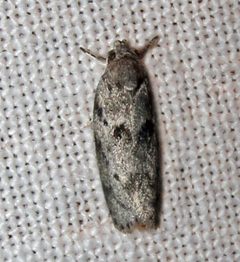
The combination of small size, nearly white forewings with very pale fuscous patches, and the specific arrangement of three small brown spots distinguishes this from similar Antaeotricha. The spot pattern—one within the margin before the middle, another slightly behind on the fold, and a third at the end of the disc—is diagnostic. It may be confused with other pale Antaeotricha species, but the specific spotting pattern and overall nearly white coloration help separate it. Dissection may be required for definitive identification from closely related species.
Images
Appearance
A small with a wingspan of approximately 14 mm. are greyish, almost white in overall coloration. The forewings bear obscure patches of very pale fuscous and three small brown spots: one within the margin before the middle, another slightly behind it on the fold, and a third at the end of the disc. Hindwings are not described in detail but are presumably pale and unmarked.
Habitat
Associated with oak forests and woodlands where plants occur. Larval consists of tied oak leaves. Specific habitat preferences are not well documented, but the is found in areas supporting Quercus species across its range.
Distribution
Eastern and central United States. Recorded from Alabama, Arkansas, Florida, Georgia, Illinois, Indiana, Kansas, Kentucky, Louisiana, Maryland, Mississippi, New Jersey, North Carolina, Ohio, Oklahoma, South Carolina, Tennessee, Texas, Virginia, and West Virginia.
Diet
Larvae feed on Quercus (oak) . Specific feeding habits are not documented.
Host Associations
- Quercus - larval food plantlarvae tie leaves of plant
Life Cycle
Larvae feed on oak leaves, tying them together for shelter. emerge and are active, though specific is not well documented. Complete with , larval, pupal, and adult stages.
Behavior
Larvae construct leaf ties on oak for feeding and shelter. is poorly documented.
Ecological Role
Larval herbivore on oak ; contributes to leaf litter processing through feeding damage. Specific ecological interactions are not well studied.
Human Relevance
No documented economic or agricultural significance. Occasionally encountered by naturalists and lepidopterists.
Similar Taxa
- Antaeotricha albulellaSimilar pale coloration, but A. albulella has one or two black spots on forewings rather than three brown spots, and has white or pale gray hindwings versus the nearly white forewings of A. humilis
- Other Antaeotricha speciesMany Antaeotricha are pale-colored and require careful examination of spotting patterns and genitalia for separation; A. humilis is distinguished by its specific three-spot pattern and nearly white ground color
More Details
Taxonomic history
Originally described as Cryptolechia humilis by Zeller in 1855, later transferred to Antaeotricha. The has been known to science for over 160 years, yet detailed biological information remains limited.
Collection records
The is represented by over 1,500 observations on iNaturalist, indicating it is encountered with some regularity by observers, though it is not considered common in collections.