
Ethmia trifurcella
(Chambers, 1873)
Ethmia trifurcella is a small in the Depressariidae, distributed across eastern and central North America. The is characterized by distinctive forewing patterning with a sinuate longitudinal line dividing dark and pale areas. Larvae are specialized herbivores that construct tubular shelters on plant leaves.
Pronunciation
How to pronounce Ethmia trifurcella: /ˈɛθ.miə traɪˈfɜːr.sɛl.lə/
These audio files are automatically generated. While they are not always 100% accurate, they are a good starting point.
Identification
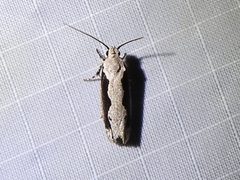
The sinuate longitudinal line on the forewing separates this from many superficially similar small . The combination of dark costal half and pale half of forewing, with a single basal spot, distinguishes it from other Ethmia species. Upturned palps (visible as horn-like projections between ) help separate Depressariidae from similar Tortricidae.
Images
Appearance
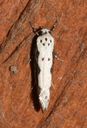
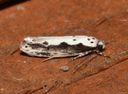
Small with forewing length 7.6–9.8 mm. Forewings divided longitudinally by a somewhat sinuate (wavy) dark line; area white or pale gray with a single dark spot at about basal one-third, costal half dark brownish to blackish. Hindwings pale brownish, slightly darker distally.
Habitat
Associated with supporting its larval plant Cynoglossum virginianum; likely includes deciduous woodlands and forest edges in eastern North America.
Distribution
North America: Pennsylvania, Ohio, Kentucky, North Carolina, northern Florida, westward to Nuevo León (Mexico), Arizona, and Wyoming.
Seasonality
active April–September with peak activity varying by region: April (Florida, Ohio), May (Kentucky), June (Nuevo León, Florida), July (Kentucky, Wyoming, Pennsylvania, Maryland), September (North Carolina). Probably (two per year).
Diet
Larvae feed exclusively on Cynoglossum virginianum (Virginia hound's tongue, Boraginaceae). diet unknown.
Host Associations
- Cynoglossum virginianum - larval Larvae feed on leaves
Life Cycle
Larvae construct tubular silk shelters on the undersides of plant leaves and feed on leaf tissue within. likely occurs within or near the larval shelter. Two per year inferred from period.
Behavior
Larvae exhibit shelter-building , constructing tubular silk retreats on leaf undersides for protection while feeding. are and attracted to light.
Ecological Role
Herbivore; larval feeding on Cynoglossum virginianum may influence plant in local . Serves as prey for .
Similar Taxa
- Other Ethmia speciesMany Ethmia share similar black-and-white or gray patterning; E. trifurcella distinguished by specific forewing pattern with sinuate dividing line and single spot
- Tortricidae (leafroller moths)Superficially similar small ; distinguished by upturned palps in Depressariidae versus flat palps in Tortricidae
More Details
Taxonomic history
Ethmia formerly placed in Coleophoridae, now in Depressariidae (Ethmiinae) based on revised phylogenetic understanding. Family placement has changed historically, reflecting ongoing revision of gelechioid relationships.
Larval shelter construction
The tubular silk shelter built by larvae on leaf undersides is a characteristic in this , providing protection from and desiccation while feeding.
Sources and further reading
- BugGuide
- Wikipedia
- GBIF taxonomy match
- iNaturalist taxon
- Catalogue of Life
- What's in a Name? Leslie Saul-Gershenz and Norm Gershenz | Bug Squad
- Bug Eric: My Personal National Moth Week, 2017
- Bug Eric: September 2017
- Bug Eric: New Mexico Night Bugs
- Nota Lepidopterologica goes advanced open access with Pensoft Publishers | Blog
- Uncategorized | Blog - Part 22