
Ethmia monticola
(Walsingham, 1880)
Gray Ethmia Moth
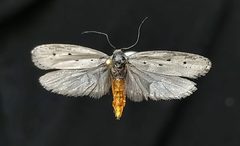
Ethmia monticola, the gray ethmia , is a small moth in the Depressariidae found across western North America. are active from May to July and are characterized by their slate gray forewings with conspicuous black markings. The exhibits considerable geographic variation across its range, with three recognized occupying distinct regions from the Pacific Northwest to the southern Rocky Mountains and eastern North America.
Pronunciation
How to pronounce Ethmia monticola: /ˈɛθ.mi.ə mɒnˈtɪ.kə.lə/
These audio files are automatically generated. While they are not always 100% accurate, they are a good starting point.
Identification
Distinguished from other Ethmia by the slate gray ground color of forewings and hindwings combined with conspicuous black forewing markings. Separation from E. discostrigella and other western Ethmia species requires examination of genitalia or detailed comparison of marking patterns. The upturned labial palps, resembling horns between the , help distinguish Depressariidae from superficially similar Tortricidae.
Images
Appearance
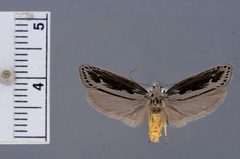
Forewing length 10.8–15.3 mm. Forewings pale to dark slate gray ground color with black, conspicuous and variable markings. Hindwings pale to dark gray. Overall coloration relatively uniform within individuals but variable across .
Habitat
Oak woodlands in foothill regions; dry mixed conifer forest with oaks at higher elevations. Associated with supporting larval plants in the Boraginaceae .
Distribution
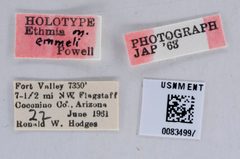
North America from British Columbia and Alberta south to California and Arizona, east to North Dakota and Colorado. Three occupy distinct ranges: E. m. monticola in western North America from Alberta through British Columbia, Washington, Montana, Wyoming, Utah, Idaho, and California mountains; E. m. emmeli in the southern Rocky Mountains and adjoining ranges; E. m. fuscipedella in eastern North America from New York, Ontario, and Manitoba south to Kansas and New Mexico.
Seasonality
on wing from May to July.
Diet
Larvae of fuscipedella feed on Lithospermum canescens and Lithospermum gmelini (Boraginaceae). Larval diet of other subspecies not documented.
Host Associations
- Lithospermum canescens - larval food plant fuscipedella only
- Lithospermum gmelini - larval food plant fuscipedella only
Life Cycle
Larvae live in a slight web. Complete details otherwise undocumented.
Behavior
Larvae construct slight webs while feeding. attracted to blacklights but reported as rare at light traps on high plains compared to foothill oak woodlands where the is described as abundant.
Ecological Role
Larval herbivore on Boraginaceae. Specific ecological role otherwise undocumented.
Human Relevance
No documented economic or medical significance. Occasionally encountered by enthusiasts and researchers.
Similar Taxa
- Ethmia discostrigellaSimilar size and appearance; both found in western North America. E. discostrigella reportedly feeds on Mountain Mahogany (Cercocarpus), distinguishing it ecologically.
- TortricidaeSuperficially similar resting posture and size. Distinguished by upturned labial palps in Ethmia (resembling horns between ) versus different palp structure in tortricids.
More Details
Taxonomic history
The Ethmia was formerly placed in Coleophoridae but is now classified in Depressariidae. This was originally described as Psecadia monticola by Walsingham in 1880.
Subspecies
Three recognized with non-overlapping geographic distributions: monticola (western ), emmeli (southern Rockies), and fuscipedella (eastern). Only fuscipedella has documented larval associations.
Sources and further reading
- BugGuide
- Wikipedia
- GBIF taxonomy match
- iNaturalist taxon
- NCBI Taxonomy
- Catalogue of Life
- What's in a Name? Leslie Saul-Gershenz and Norm Gershenz | Bug Squad
- Bug Eric: My Personal National Moth Week, 2017
- Bug Eric: September 2017
- Bug Eric: New Mexico Night Bugs
- Nota Lepidopterologica goes advanced open access with Pensoft Publishers | Blog
- Bug Eric: A Flower Scarab, Euphoria fulgida