
Paranthrene tabaniformis
(Rottemburg, 1775)
dusky clearwing, dusky clearwing moth, poplar clearwing moth
Paranthrene tabaniformis, the dusky clearwing moth, is a sesiid native to the Palearctic and Nearctic realms. The exhibits of , with transparent wings and wasp-like coloration. are active from May to August, with activity varying by location. The larvae are wood-borers that develop through 6-7 instars, feeding internally on poplar, willow, and sea-buckthorn before pupating in chambers within larval galleries.
Pronunciation
How to pronounce Paranthrene tabaniformis: /pəˈrænθrɛniː tæˌbænɪˈfɔːrmɪs/
These audio files are automatically generated. While they are not always 100% accurate, they are a good starting point.
Identification
The dusky clearwing can be distinguished from other Paranthrene by its association with Populus and the specific pattern of yellow abdominal rings. It resembles in general appearance, but lacks the constricted waist and has two pairs of wings (the hind pair reduced and transparent). It differs from P. diaphana, which feeds primarily on Salix and has patchy distribution in southeastern Europe, and from P. insolitus. The transparent wing patches with dark venation are characteristic of the Sesiidae . can be monitored using sex attractant lures.
Images
Appearance
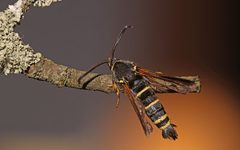
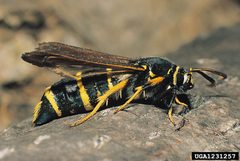
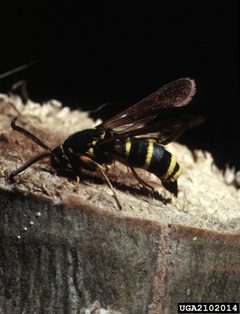
have a wingspan of approximately 30 mm and forewing length of approximately 14 mm. The bears a white vertical bar before each and a yellow ring. The displays yellow rings on segments 2, 4, 6, and sometimes 7. Middle and posterior tibiae are orange with black bands. Forewings are dark fuscous with an elongate obscure hyaline patch toward the base and a violet-blackish costal streak. Hindwings are hyaline with dark fuscous and termen. occurs in : female antennae are with more flagellomeres, while male antennae are pectinate.
Habitat
Associated with stands of poplar (Populus spp.), willow (Salix), and sea-buckthorn (Hippophae). In young plantations, males fly at heights up to 3.0 m, roaming along tree tops and vegetation. In mature stands with trees approximately 15 m tall, activity extends to greater heights. Larval galleries occur in one-year-old poplar seedlings, beneath bark of stems and branches in older trees, and in shoots of plants.
Distribution
Palearctic and Nearctic realms. Recorded across Europe including Bulgaria, Romania, Belgium, and the Netherlands. Present in North America. Within Bulgaria, documented at 11 localities with established in poplar stands.
Seasonality
fly from May to August depending on location. In Bulgaria, adult occurs approximately one month after emergence in April. activity peaks vary regionally.
Diet
Larvae feed on poplar (Populus spp.), willow (Salix spp.), and sea-buckthorn (Hippophae rhamnoides). feeding habits are not explicitly documented in available sources.
Host Associations
- Populus - larval primary ; larvae bore in shoots, stems, and branches
- Salix - larval recorded plant
- Hippophae rhamnoides - larval sea-buckthorn; recorded plant
- Apanteles evonymellae - solitary endoparasitoid of early-stage larvae; causes 2.4-35.4% mortality (average 17.3% in Bulgaria)
- Eriborus terebrans - solitary internal larval ; causes up to 39% mortality in summer , average 4.7% in larvae
- Bracon intercessor - gregarious external larval ; causes 1.5% mortality in larvae, 3.2-5.8% in summer
Life Cycle
Larvae develop through 6-7 instars. Mature larvae pupate in chambers constructed within larval galleries. Pupae occur in the center of one-year-old poplar seedlings or beneath bark of stems and branches in older trees. occurs as larvae. In Bulgaria, in spring follows approximately one month after emergence. The is or partially depending on region.
Behavior
are effective fliers. Males use for mate location and exhibit patterns concentrated at lower heights (up to 3.0 m) in young plantations, with 90% of males flying at these levels. In mature stands, flight activity increases with height. Adults are and exhibit -mimicking appearance, possibly as . Parasitized larvae construct conical '' structures of and silk over gallery openings before death, which may protect pupae from hyperparasites and .
Ecological Role
Larvae function as wood-boring herbivores in poplar and willow stands, contributing to nutrient cycling through gallery formation in dead and living wood. The serves as for multiple (Apanteles evonymellae, Eriborus terebrans, Bracon intercessor), supporting parasitoid in forest . wasp-mimicry may influence -prey dynamics.
Human Relevance
Considered a pest of poplar plantations and urban poplars, with larvae damaging shoots, stems, and branches. have been tested for 'lure and kill' and mass trapping management, though studies showed reduced male capture without statistically significant decreases in rates compared to untreated plots. The is subject to research through conservation and .
Similar Taxa
- Paranthrene diaphanaMorphologically similar clearwing moth, but distinguished by primary association with Salix (willow) rather than Populus, and patchy distribution in southeastern Europe versus widespread range of P. tabaniformis
- Paranthrene insolitusThird European Paranthrene ; distribution and preferences differ from P. tabaniformis
- Sesiidae (family members)Other clearwing moths share transparent wing areas and -mimicry; distinguished by specific abdominal ring patterns, associations, and responses
More Details
Sexual dimorphism in sensory structures
Female are with greater numbers of flagellomeres; male antennae are pectinate. Seven types of antennal and three types of sensilla have been identified through scanning electron microscopy, with differences in number, distribution, length, and basal width between sexes.
Subspecies
Three recognized: P. t. tabaniformis, P. t. kungessana (Alpheraky, 1882), and P. t. synagriformis (Rambur, 1866)
Flight behavior research
Sex attractant studies revealed that trap height significantly influences male capture rates in mature stands, with most males in young plantations flying below 3.0 m and roaming along vegetation tops.
Sources and further reading
- BugGuide
- Wikipedia
- GBIF taxonomy match
- iNaturalist taxon
- NCBI Taxonomy
- Catalogue of Life
- Carpenter Bee: Beneficial Insect or Pest? | Bug Squad
- Innovative Research by RSPIB Scholar: Surprising Find About Carpenter Bees | Bug Squad
- UC Davis Bee Haven: Celebrating a Year of Bloom, Stewardship and Community Impact | Bug Squad
- Insect FAQs | Entomology Research Museum
- Bug Spotlight | Entomology Research Museum
- Love at First Flight | Bug Squad
- Antennal and proboscis sensilla characteristics of Paranthrene tabaniformis (Lepidoptera: Sesiidae)
- Studies on the efficacy of the sex attractant ofParanthrene tabaniformisRott. (Lep., Sesiidae)
- Bioecological characteristics of Bracon intercessor Nees (Hymenoptera: Braconidae) as a parasitoid of the poplar clearwing moth, Paranthrene tabaniformis (Rott.) (Lepidoptera: Sesiidae) in Bulgaria
- Studies on larval parasitoids of Paranthrene tabaniformis (Rott.) (Lepidoptera: Sesiidae) on urban poplars (Populus spp.) in Sofia, Bulgaria
- Notes on the biology and ecology of the parasitoids of the poplar clearwing moth, Paranthrene tabaniformis (Rott.) (Lep., Sesiidae) in Bulgaria. II. Eriborus terebrans (Gravenhorst, 1826) (Hym., Ichneumonidae)
- Notes on the biology and ecology of the parasitoids of the poplar clearwing moth, Paranthrene tabaniformis (Rott.) (Lep., Sesiidae) in Bulgaria. I. Apanteles evonymellae (Bouché, 1834) (Hym., Braconidae)
- Paranthrene diaphana: a new clearwing moth (Lepidoptera: Sesiidae) species in Romania and its preliminary response to sex attractants