
Synanthedon rhododendri
(Beutenmüller, 1909)
Rhododendron Borer Moth
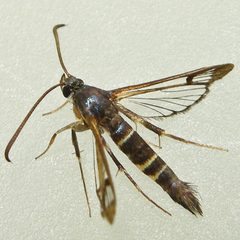
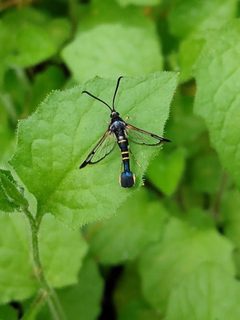
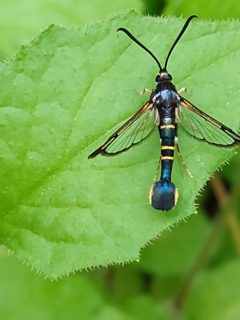
Synanthedon rhododendri is a clearwing moth in the Sesiidae, commonly known as the rhododendron borer . The is a pest of rhododendrons and related Ericaceae, with larvae boring into stems and crowns of plants. are and exhibit -mimicking appearance typical of the family. The species occurs in the Nearctic region.
Pronunciation
How to pronounce Synanthedon rhododendri: //ˌsaɪnænˈθɛdɒn ˌroʊdəˈdɛndraɪ//
These audio files are automatically generated. While they are not always 100% accurate, they are a good starting point.
Identification
Distinguished from other clearwing moths by association with rhododendron and specific geographic range. Similar to other Synanthedon but separable by host plant specificity and subtle morphological differences in genitalia and pattern details. Distinguished from actual by wing structure (two pairs of wings, not one), shape, and . From other Sesiidae by the combination of dark coloration with pale markings and Nearctic distribution centered on eastern North America.
Images
Appearance
have transparent wings with reduced scaling, dark margins, and narrow wing fringes. Body is dark with contrasting pale markings. are bipectinate in males, in females. The overall appearance mimics hymenopteran , with a slender wasp-waisted profile and often yellow or orange banding on .
Habitat
Associated with cultivated and native rhododendrons and azaleas in woodland edges, gardens, and ornamental plantings. Larval is within living stems and crowns of plants. are found near host plants during daylight hours.
Distribution
Nearctic region, primarily eastern North America. Records indicate presence in areas where rhododendrons and azaleas are cultivated or native.
Seasonality
active during warmer months; specific period varies by latitude but generally late spring through summer. Larvae present within plants year-round.
Diet
Larvae bore into and feed on the stems, crowns, and roots of rhododendrons (Rhododendron spp.) and related Ericaceae. feeding habits unknown; likely minimal or nectar-based if any.
Host Associations
- Rhododendron - primary larval food plant; larvae bore into stems and crowns
Life Cycle
Complete with four stages: , larva, pupa, . Larvae are stem borers, tunneling into rhododendron stems and crowns where they feed and develop. occurs within the plant or in soil. Adults emerge and are . Specific timing of varies; likely or partially depending on region.
Behavior
are and active during daylight, rarely attracted to artificial lights. Males use feathery to detect female . Adults are rapid, -like fliers that often hover near plants. Larvae are concealed feeders within host tissues.
Ecological Role
As a herbivore, larvae damage rhododendrons by boring into vascular tissues, potentially weakening or killing plants. Serves as prey for birds and other . -mimicry may provide protective against .
Human Relevance
Significant pest of ornamental rhododendrons and azaleas in gardens and nurseries. Larval boring causes dieback, crown damage, and plant death in heavy . Management includes pruning infested stems, applications, and trapping for monitoring. Native plantings may be affected as noted in horticultural contexts.
Similar Taxa
- Synanthedon scitulaSimilar clearwing moth with overlapping range; distinguished by association (dogwood and other Cornaceae rather than Ericaceae) and subtle pattern differences.
- Synanthedon acerniAnother eastern North American clearwing; associated with maple (Acer) rather than rhododendron.
- Euhagena nebraskaeWestern clearwing moth with similar -mimicking appearance; distinguished by geographic range (Great Plains and western regions) and associations.
Misconceptions
Often mistaken for or due to wasp-mimicking appearance and . The 'borer' is sometimes confused with other rhododendron pests, but this is specifically a sesiid larva, not a borer.
More Details
Pheromone attraction
Males are attracted to synthetic lures, which can be used for monitoring and collection. This trait is shared with many Sesiidae and distinguishes them from most Lepidoptera in survey methods.
Taxonomic history
Originally described as Sesia rhododendri by Beutenmüller in 1909, later transferred to Synanthedon. The specific epithet directly references the plant .