
Synanthedon polygoni
(Edwards, 1881)
Buckwheat Root Borer Moth
A clearwing moth ( Sesiidae) whose larvae bore into the roots and crowns of buckwheat and related plants. exhibit -like mimicry with reduced wing scaling and are primarily . The is found across western North America from the Great Plains to the Pacific.
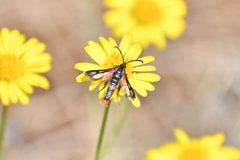
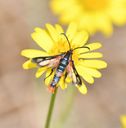
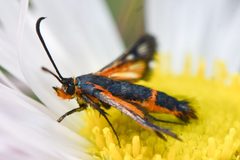
Pronunciation
How to pronounce Synanthedon polygoni: //sɪˈnænθɪˌdɒn pəˈlɪɡəni//
These audio files are automatically generated. While they are not always 100% accurate, they are a good starting point.
Identification
Distinguished from other clearwing moths by plant association with buckwheat (Polygonaceae ). Similar to other Synanthedon but can be separated by geographic range and host specificity. The combination of -mimicking , reduced wing venation visibility due to scaling patterns, and association with Polygonaceae hosts helps distinguish it from related clearwing borers.
Images
Appearance
have narrow, elongated wings with reduced scaling that creates transparent or semi-transparent areas, giving a -like appearance. The body is slender with dark coloration, often with pale or yellowish markings. Males possess strongly bipectinate (feathery) . The has hair-like , and wing margins have flattened scales. Overall appearance mimics hymenopteran wasps in .
Habitat
Open including prairies, grasslands, and semi-arid regions where plants in the buckwheat occur. Associated with sandy or well-drained soils supporting Polygonaceae vegetation.
Distribution
Western North America: recorded from Alberta, Canada southward through the Great Plains and western United States to Mexico. Specific records include Nebraska, Kansas, and Pacific coastal regions.
Seasonality
active in late summer and early fall, with observations from August through October. Peak activity varies with latitude and local climate conditions.
Diet
Larvae feed internally on roots and crowns of plants in the Polygonaceae , particularly buckwheat (Eriogonum and cultivated Fagopyrum). do not feed.
Host Associations
- Eriogonum - larval wild buckwheat
- Fagopyrum - larval cultivated buckwheat
Life Cycle
Complete with internal feeding larval stage. Larvae tunnel in roots and crowns of plants, causing damage to vascular tissues. occurs within the host plant or in soil near the base of the plant. emerge in late summer. Specific details of -laying and number of per year are not well documented.
Behavior
are and active during daylight hours. They are generally not attracted to light traps, making detection difficult without lures. is -like with rapid, erratic movements that enhance hymenopteran mimicry. Males can be observed perching on vegetation, sometimes cooperatively allowing close approach.
Ecological Role
As a root borer, larvae influence plant of Polygonaceae . The species contributes to nutrient cycling through herbivory and serves as prey for insectivorous birds and other . mimicry may reduce pressure through .
Human Relevance
Considered a pest of cultivated buckwheat in agricultural settings. Larval feeding damages roots and crowns, reducing crop vigor and yield. Management is complicated by the cryptic larval habit and the general unattractiveness of to light-based monitoring methods. lures have been used for detection and monitoring.
Similar Taxa
- Synanthedon acerniAlso in Synanthedon and occasionally attracted to lights, but associated with maple (Acer) rather than Polygonaceae
- Synanthedon scitulaSimilar size and appearance, also occasionally at lights, but associated with dogwood (Cornus) and other woody plants
- Euhagena nebraskaeAnother western clearwing moth with mimicry and bipectinate male , but associated with different plants and with more prominent white thoracic tufts in males
Misconceptions
Often mistaken for due to and appearance; this mimicry is adaptive but leads to misidentification by casual observers. The 'Buckwheat Root Borer' may incorrectly suggest association with wheat (Triticum) rather than true buckwheat (Fagopyrum) and wild buckwheat (Eriogonum).
More Details
Collection challenges
The exemplifies the difficulty of studying many Sesiidae: are , not attracted to lights, and have brief adult periods. lures are the most effective detection method.