
Synanthedon culiciformis
(Linnaeus, 1758)
large red-belted clearwing, Large Red-belted Clearwing Moth
Synanthedon culiciformis is a clearwing moth in the Sesiidae, distributed across the Palearctic and Nearctic realms. are active from April to August and exhibit -mimicking coloration. The develops as a wood-boring larva in deciduous trees, particularly birch and alder.
Pronunciation
How to pronounce Synanthedon culiciformis: //ˌsɪnænˈθiːdɒn ˌkjuːlɪsɪˈfɔːrmɪs//
These audio files are automatically generated. While they are not always 100% accurate, they are a good starting point.
Identification
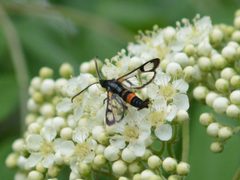
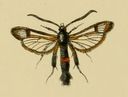
have clear, largely scaleless wings with dark margins and , creating a -like appearance in . The wingspan measures 23–27 mm, with forewing length of 12–14 mm. The body shows a prominent red or orange band across the (the "red-belted" feature), with yellow and black patterning on the . are bipectinate in males, narrower in females. Distinguished from other Synanthedon by the combination of larger size, distinct abdominal banding, and association with birch and alder.
Images
Distribution
Palearctic and Nearctic ecozones; recorded from Belgium and broadly across Europe and North America.
Seasonality
fly from April to August, with timing varying by location.
Diet
Larvae feed internally on wood of various deciduous trees, especially birch (Betula spp.) and alder (Alnus spp.).
Host Associations
- Betula - larval food plantprimary
- Alnus - larval food plantsecondary
Behavior
are and generally uninterested in light traps; males are attracted to lures. The clear wings and -mimicking coloration provide protective mimicry during daytime .
Ecological Role
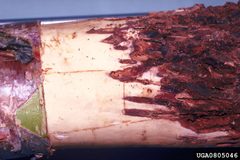
Larvae act as wood-boring insects in living deciduous trees, contributing to nutrient cycling and creating internal galleries in stems. may serve as during their brief adult life.
Human Relevance
Larvae can cause damage to ornamental and native birch plantings. lures are used for monitoring and research purposes.
Similar Taxa
- Synanthedon scitulaSmaller size, different preferences (often dogwood), lacks prominent red abdominal banding.
- Synanthedon acerniAssociated with maple , different abdominal patterning.
- Synanthedon fatiferaBores into Viburnum rather than birch/alder; different coloration with purple-blue-black tones and white spots.