
Alcathoe verrugo
(Druce, 1884)
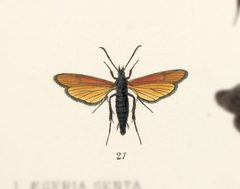
Alcathoe verrugo is a clearwing moth in the Sesiidae, native to the New World tropics and southern United States. Like other sesiids, it exhibits mimicry, with transparent wings and a slender body that resembles hymenopterans in . The Alcathoe contains five north of Mexico, all rarely encountered. Males possess a single tail-like abdominal appendage that approximates the dangling legs of wasps.
Pronunciation
How to pronounce Alcathoe verrugo: /ælˈkæθoʊ vɛˈruːgoʊ/
These audio files are automatically generated. While they are not always 100% accurate, they are a good starting point.
Identification
Distinguished from other clearwing moths by the male's single tail-like abdominal appendage (approximating legs) and highly bipectinate . The Alcathoe is restricted to the New World tropics and southern United States; among the five north of Mexico, identification to species level typically requires microscopic examination. Resembles wasps in but settles with wings folded differently than hymenopterans.
Images
Appearance
Clearwing moth with transparent wings due to reduced scaling. Wings have flattened marginal visible upon close examination. Body slender and -like. Males have highly bipectinate (feathery) and a single tail-like appendage trailing from the abdominal tip. with wispy, hair-like scales forming white tufts.
Habitat
Associated with Clematis plants. Occurs in areas where larval host plants grow, including open and edges where Clematis are present.
Distribution
New World tropics north into the southern United States. Nearctic and . Records from Colorado and other southwestern states.
Seasonality
active in mid-summer; observed in July in Colorado.
Host Associations
- Clematis - larval plantCaterpillars are stem borers in Clematis
Life Cycle
Larval stage consists of stem-boring caterpillars in Clematis stems. timing corresponds with plant .
Behavior
, active during daylight hours. Visits flowers for nectar. pattern -like but distinct upon close observation. Not attracted to artificial lights. Males may be observed perching on vegetation.
Ecological Role
of flowers when visiting for nectar. Larval boring activity in Clematis stems contributes to plant .
Human Relevance
Occasionally encountered by entomologists and naturalists due to mimicry, sometimes initially mistaken for spider wasps or tarantula hawks. Rarely collected due to habits and lack of attraction to lights.
Similar Taxa
- Alcathoe pepsioidesCongeneric clearwing moth with similar -mimic appearance and male abdominal appendage; distinguished by specific morphological details requiring expert examination
- Euhagena nebraskaeAnother sesiid clearwing moth with mimicry and in ; belongs to different with different plant associations
- Synanthedon spp.Clearwing moths with similar transparent wings and -like appearance; some attracted to lights unlike Alcathoe, and lack the male tail-like abdominal appendage
More Details
Taxonomic history
Originally described as Sannina verrugo by Druce in 1884; later transferred to Alcathoe. The genus was established by H. Edwards in 1882.
Collection challenges
Like most sesiids, not attracted to light traps; best collected using lures or by searching plants. Most specimens require microscopic examination for definitive identification.