
Carposina
Herrich-Schäffer, 1853
Species Guides
3- Carposina fernaldana(Currant Fruitworm Moth)
- Carposina ottawana(American Peach Fruit Moth)
- Carposina simulator
Carposina is a of small in the Carposinidae, containing approximately 100 described distributed across multiple continents. The genus includes significant agricultural pests, notably Carposina sasakii (peach fruit moth), whose larvae bore into fruits of Rosaceae and Rhamnaceae. Species exhibit internal fruit-feeding habits as larvae and complete with documented digestive tract reconstruction during to accommodate dietary shifts from solid to liquid food.
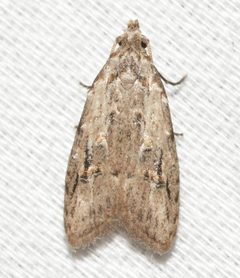
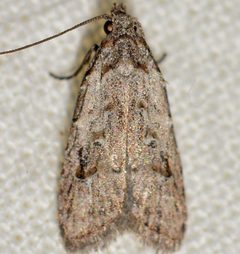
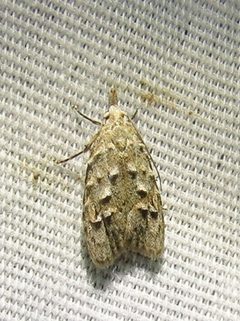
Pronunciation
How to pronounce Carposina: /kɑːrpoʊˈsiːnə/
These audio files are automatically generated. While they are not always 100% accurate, they are a good starting point.
Identification
Carposina are small typically requiring dissection or molecular methods for definitive identification. Carposina sasakii can be distinguished from similar orchard pests Grapholita dimorpha and Grapholita molesta using multiplex : C. sasakii produces a 375 species-specific product, versus 125 and 234 bp for G. dimorpha and 125 bp for G. molesta. generally have unremarkable wing patterns; larvae are internal feeders within fruits.
Images
Habitat
Orchards and areas with plants in Rosaceae and Rhamnaceae. Carposina sasakii has been observed in apple and peach orchards.
Distribution
Widespread across temperate and subtropical regions of Asia, Europe, and North America. Carposina sasakii occurs in China (Beijing, Guangdong, Hebei, Heilongjiang, Henan, Jiangsu, Liaoning, Ningxia, Shandong, Shaanxi, Shanxi, Zhejiang), Japan, Korea, and Russia (Amurskaya region, Khabarovsk, Primorskii area, Sakhalin). Distribution records from GBIF include Vermont, USA.
Diet
Larvae feed internally on fruit flesh; feed on liquid food. Carposina sasakii larvae bore into fruits after hatching from laid on the hairy surface of fruit stalk cavities and calyx ends.
Host Associations
- Malus pumila - apple
- Prunus persica - peach
- Pyrus - pear
- Prunus armeniaca - apricot
- Prunus domestica - plum
- Crataegus - hawthorn
- Cydonia oblonga - quince
- Ziziphus sativa -
Life Cycle
Complete with , larval, pupal, and stages. In Carposina sasakii, eggs are laid on fruit surfaces; larvae bore into fruits to feed on flesh, then exit to pupate. Digestive tract undergoes morphological reconstruction during the pupal stage: the crop transforms from a spherical larval structure to an enlarged lateral bag-like structure, and the changes from columnar to a dilated rectal sac, accommodating the shift from solid larval to liquid adult diet.
Behavior
exhibit chemosensory-based location. Three chemosensory proteins (CsasCSP7, CsasCSP9, CsasCSP11) in Carposina sasakii bind specific host plant volatiles: CsasCSP7 to benzaldehyde and dodecanal, CsasCSP9 to butyl octanoate, decanal and (-)-beta-pinene, and CsasCSP11 to 1-hexanol, beta-ocimene and 6-methyl-5-hepten-2-one. Males are attracted to female ; this trait has been exploited for control.
Ecological Role
Significant agricultural pest causing internal fruit damage. Larval feeding reduces fruit quality and marketability. High ability between fruit-generating periods regardless of spatial and temporal conditions.
Human Relevance
Major economic pest of stone and pome fruits in East Asia. Carposina sasakii is managed through -based , with dispensers originally developed for this being used to control related pests such as Coscinoptycha improbana (guava ) in New Zealand. Sublethal exposure affects and mating . Rapid molecular diagnostics are used for larval identification in programs.
Similar Taxa
- Grapholita dimorphaCo-occurs in orchards and has similar larval fruit-boring habit; distinguished by multiplex (125 and 234 product versus 375 bp for Carposina sasakii)
- Grapholita molestaCo-occurs in orchards with similar ; distinguished by multiplex (125 product versus 375 bp for Carposina sasakii) and typically higher on peach
- Coscinoptycha improbanaRelated fruit-feeding with similar ; responds to Carposina sasakii due to chemical similarity, enabling cross-
More Details
Chemosensory protein research
Molecular studies of Carposina sasakii have characterized three chemosensory proteins with distinct expression patterns: CsasCSP7 and CsasCSP9 are abundantly expressed in male , while CsasCSP11 is highly expressed in female wings, suggesting sex-specific roles in location.
Population genetics
Carposina sasakii in Korea exhibit moderate haplotype diversity (0.319–0.699) and low diversity (0.0006–0.0045), with no significant genetic structure corresponding to province, plant, fruit type, or collection period, indicating high capability.
Sources and further reading
- BugGuide
- Wikipedia
- GBIF taxonomy match
- iNaturalist taxon
- NCBI Taxonomy
- Catalogue of Life
- Carposina sasakii . [Distribution map].
- Molecular Characterization of Three Chemosensory Proteins from Carposina sasakii
- Digestive system formation during metamorphosis of Carposina sasakii Matsumura, 1900 (Lepidoptera: Carposinidae)
- Guava moth (<i>Coscinoptycha improbana</i>) mating disruption using Asian peach moth (<i>Carposina sasakii</i>) pheromone dispensers
- Larval species composition and genetic structures ofCarposina sasakii,Grapholita dimorpha, andGrapholita molestafrom Korea
- Sublethal Concentration of Beta-Cypermethrin Influences Fecundity and Mating Behavior ofCarposina sasakii(Lepidoptera: Carposinidae) Adults
- Quantifying Key Environmental Determinants Shaping the Ecological Niche of Fruit Moth Carposina sasakii Matsumura, 1900 (Lepidoptera, Carposinidae).