
Carposinidae
fruitworm moths
Genus Guides
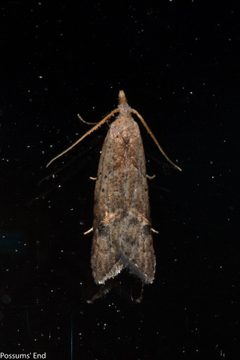
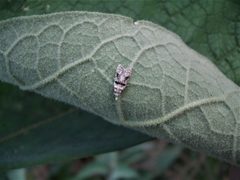
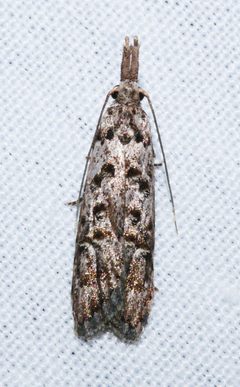
3, commonly known as fruitworm moths, is a of Lepidoptera characterized by diagnostic mouthpart structures and wing venation. are typically greenish or greyish with camouflage patterning and are , attracted to light. Larvae are internal feeders, developing within leaves, flowers, fruits, buds, or plant galls. The family has a distribution except for the north-western Palearctic region. Some are significant agricultural pests, particularly those infesting fruit crops.
Pronunciation
How to pronounce Carposinidae: //ˌkɑːrpəˈsɪnɪdiː//
These audio files are automatically generated. While they are not always 100% accurate, they are a good starting point.
Identification
Distinguished from the related Copromorphidae by narrower wings with less rounded forewing tips, and by the absence of the M2 and sometimes M1 on the hindwings. The upcurved labial palps with elongated third segment and large-scaled second segment are diagnostic mouthpart features. Males often display conspicuous patches on wing surfaces.
Images
Appearance
are greenish or greyish with camouflage patterns. Males often have conspicuous patches of on either wing surface. The labial palps are prominent and upcurved, with the third segment elongated (especially in females) and the second segment covered in large scales. Wings are narrower than those of Copromorphidae, with less rounded forewing tips. Hindwings lack the M2 and sometimes the M1 vein, distinguishing them from Copromorphidae.
Habitat
are defined by larval plant associations; specific habitat types for are not well documented beyond attraction to light sources.
Distribution
Worldwide distribution except the north-western Palearctic region. Documented from North Macedonia, Romania, China, New Zealand, and North America (Vermont, USA).
Seasonality
activity pattern documented; specific seasonal timing varies by and region.
Diet
Larvae feed internally on plant tissue of gymnosperms (Podocarpaceae) and diverse dicot including Asteraceae, Campanulaceae, Ericaceae, Fagaceae, Myrtaceae, Rosaceae, Proteaceae, and Rutaceae. feed on liquid food; the undergoes reconstruction during to accommodate this dietary shift from solid larval food.
Host Associations
- Podocarpaceae - larval gymnosperm
- Asteraceae - larval dicot
- Campanulaceae - larval dicot
- Ericaceae - larval dicot
- Fagaceae - larval dicot
- Myrtaceae - larval dicot
- Rosaceae - larval dicot ; includes Malus pumila (apple)
- Proteaceae - larval dicot
- Rutaceae - larval dicot
- Rubus ostryfolius - larval blackberry; successfully reared in laboratory
- Malus pumila - larval apple; significant agricultural pest association
Life Cycle
Complete with , larva, pupa, and stages. Larvae develop through four instars. In Heterocrossa rubophaga, egg development averages 8 days, larval period 18.6–20.8 days, prepupal and pupal period 20.8–22.1 days, with total development from to adult averaging 40.7–41.6 days under laboratory conditions (20°C, 50–60% RH, 18 h ). During , the digestive tract undergoes major reconstruction: the larval crop transforms from spherical to an enlarged lateral bag-like structure, and the changes from columnar to a dilated rectal sac to accommodate the shift from solid to liquid feeding. Larvae pupate within their larval shelter or descend to ground level to form detritus-covered cocoons.
Behavior
are and attracted to light. Larvae are internal feeders, living within leaves, flowers, fruits, buds, or galls within plant tissue. In Carposina sasakii, sublethal concentrations of beta-cypermethrin have been observed to influence and mating in adults.
Ecological Role
Internal feeding larvae act as herbivores on diverse plant . Some function as significant agricultural pests due to fruit .
Human Relevance
Several are agricultural pests, notably Carposina niponensis (peach fruit ) and Carposina sasakii, which infest fruit crops including apple and peach. These species are subjects of toxicological and pathological research for pest management.
Similar Taxa
- Copromorphidae can be distinguished by narrower wings with less rounded forewing tips, and by the absence of M2 and sometimes M1 on the hindwings (present in Copromorphidae). The relationship between these requires further investigation; Carposinidae may be nested within Copromorphidae.
More Details
Taxonomic Uncertainty
The relationship of relative to Copromorphidae requires further investigation. It is considered possible that Carposinidae is an artificial grouping nested within Copromorphidae (Dugdale et al., 1999).
Digestive System Reconstruction
The pupal stage involves major morphological restructuring of the digestive tract to accommodate the transition from solid larval food to liquid food, with the crop and undergoing particularly dramatic .
Sources and further reading
- BugGuide
- Wikipedia
- GBIF taxonomy match
- iNaturalist taxon
- NCBI Taxonomy
- Catalogue of Life
- Digestive system formation during metamorphosis of Carposina sasakii Matsumura, 1900 (Lepidoptera: Carposinidae)
- Commatarcha galicicae Tokár & Srnka, sp. nov., and a genus new for Europe (Lepidoptera, Carposinidae)
- Laboratory rearing of the raspberry bud moth, Heterocrossa rubophaga (Lepidoptera: Carposinidae) on blackberry
- Sublethal Concentration of Beta-Cypermethrin Influences Fecundity and Mating Behavior ofCarposina sasakii(Lepidoptera: Carposinidae) Adults
- Effect of Host Plants on Developmental Time and Life Table Parameters of <I>Carposina sasakii</I> (Lepidoptera: Carposinidae) Under Laboratory Conditions
- Quantifying Key Environmental Determinants Shaping the Ecological Niche of Fruit Moth Carposina sasakii Matsumura, 1900 (Lepidoptera, Carposinidae).