
Hyles gallii
von Rottemburg, 1775
Bedstraw Hawkmoth, Galium Sphinx
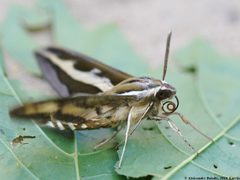
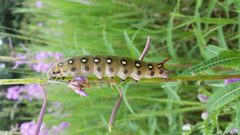
Hyles gallii is a sphinx moth (Sphingidae) commonly known as the Bedstraw Hawkmoth or Galium Sphinx. It is a medium-sized hawkmoth with a wingspan typically ranging 50-70 mm. The is widely distributed across the Northern Hemisphere, including North America and Eurasia. are known for their rapid, hovering and are primarily or , though they may be active during daylight hours. The larvae feed primarily on plants in the Galium (bedstraws), giving the species its .

Pronunciation
How to pronounce Hyles gallii: /ˈhɪlɛs ˈɡali.aɪ/
These audio files are automatically generated. While they are not always 100% accurate, they are a good starting point.
Identification
Hyles gallii can be distinguished from the similar Hyles lineata (White-lined Sphinx) by the more uniform olive-brown forewing coloration without the strong white line characteristic of H. lineata. The hindwing pattern differs in having a more extensive black basal area. H. gallii is also generally smaller than H. lineata. In North America, it can be separated from Hyles euphorbiae by wing pattern and geographic distribution. The larval plant association with Galium is a key ecological indicator.
Images
Habitat
Open including meadows, grasslands, forest edges, gardens, and disturbed areas where plants (Galium ) occur. Found from sea level to montane elevations.
Distribution
Holarctic distribution: North America (across Canada and the northern United States, southward in mountains), Europe (widespread), and Asia (northern and central regions). Records include Belgium, and throughout northern and central Europe. In North America, present across the and temperate regions.
Seasonality
typically fly from late spring through summer, with peak activity in June-August depending on latitude. Usually single-brooded in northern parts of range, potentially partial second in southern areas. Overwinters as pupa in subterranean chamber.
Host Associations
- Galium - primary larval plantlarvae feed on various bedstraw
- Rubia - larval plantoccasionally used
Life Cycle
Complete . laid on plant leaves. Larvae feed on Galium , sometimes defoliating plants. Mature larvae descend to ground and burrow several centimeters into soil to form pupal chamber. Pupae overwinter, with emerging the following spring or summer.
Behavior
exhibit rapid, sustained hovering while feeding at flowers using a long . Primarily and , but occasionally . Attracted to light. Adults are capable of long-distance . Larvae may wander between plants when food is depleted.
Ecological Role
serve as of various flowering plants. Larvae function as herbivores, occasionally reaching densities that can impact plant . Serve as prey for various including birds, bats, and insects.
Human Relevance
Occasional minor pest in gardens when larval are high. are appreciated by naturalists and photographers for their attractive appearance and hovering . Sometimes mistaken for hummingbirds due to flight pattern.
Similar Taxa
- Hyles lineataSimilar size and general appearance, but H. lineata has prominent white lines on forewings, larger average size, and broader plant range including evening primroses
- Hyles euphorbiaeOverlapping range in Europe; H. euphorbiae has different forewing pattern with more contrasting markings and feeds primarily on Euphorbia
- Hyles vespertilioSimilar European distribution; distinguished by wing pattern and more restricted preferences
Sources and further reading
- BugGuide
- GBIF taxonomy match
- iNaturalist taxon
- NCBI Taxonomy
- Catalogue of Life
- Ready for Moth Night at UC Davis? | Bug Squad
- A Buggy New Year! | Bug Squad
- Oh, What a (Moth) Night This Will Be! A Conversation With Bohart's Lepidoptera Curator Jeff Smith | Bug Squad
- Don't Miss Bohart Museum Open House on Nov. 2 | Bug Squad
- 'A Night at the Bohart Museum' to Celebrate Moths and Other Insects | Bug Squad
- Bug Eric: White-lined Sphinx ("Hummingbird Moth")