
Rothschildia
Grote, 1896
Species Guides
3- Rothschildia cinctus(Cincta Silk Moth)
- Rothschildia lebeau(Lebeau's Silk Moth)
- Rothschildia orizaba(Orizaba silkmoth)
Rothschildia is a of giant silkmoths in the Saturniidae, first described by Augustus Radcliffe Grote in 1896. The genus contains approximately 30 described distributed from the southern United States through Mexico and Central America to Argentina. are characterized by large size, reduced or mouthparts, and often striking wing patterns including transparent "windows" devoid of . Several species have documented cultural significance for peoples, particularly the use of cocoons in ceremonial regalia.
Pronunciation
How to pronounce Rothschildia: //rɒθˈtʃɪldiə//
These audio files are automatically generated. While they are not always 100% accurate, they are a good starting point.
Identification
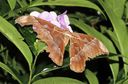
Rothschildia can be distinguished from other Saturniidae by the combination of large body size, broad wings, and frequently present transparent wing windows (areas lacking ). The Forbes Moth (Rothschildia lebeau forbesi) is frequently mistaken for the Atlas (Attacus atlas) due to similar window patterns, but differs in smaller wingspan (90–100 mm versus 240 mm) and geographic range. Specific species-level identification requires examination of genitalia and detailed wing pattern characteristics.
Images
Habitat
occupy forest , with documented occurrence in tropical dry forests and orchards. Rothschildia lebeau occurs in tropical dry forest of northwestern Rica. Rothschildia cincta cincta inhabits dry forests and orchards in Sinaloa, Mexico.
Distribution
North America and South America, from the United States (southern range) through Mexico and Central America to Argentina. Specific documented localities include: Lower Rio Grande Valley (USA) through eastern Mexico to Brazil (R. lebeau forbesi); Sinaloa and Nayarit, Mexico (R. cincta cincta); tropical dry forest of northwestern Rica (R. lebeau); Alter do Chão, Santarém, Pará, Brazil (R. erycina).
Diet
do not feed; they possess mouthparts and rely on fat reserves accumulated during larval development. Larval plants include Eriotheca candolleana (Malvaceae) for R. erycina, and three tree (unspecified in available sources) for R. lebeau in Rican dry forest.
Host Associations
- Eriotheca candolleana - larval First recorded for Rothschildia erycina; documented in Alter do Chão, Brazil
- unspecified tree species - larval Three primary tree used by Rothschildia lebeau in Rican dry forest
Life Cycle
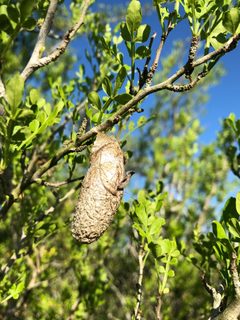
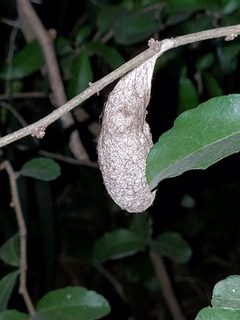
Complete with , larva, pupa, and stages. Caterpillars are large and heavy at maturity. occurs within silk cocoons. Adults are short-lived, surviving only a few days. Females invest heavily in egg production and rarely stray far from cocoons after , even depositing eggs in quantity if unmated.
Behavior
Females remain near sites and emit -specific to attract males. Males possess broad wings, streamlined bodies, and sensitive ; they have been observed following pheromone trails for distances exceeding one mile. Mated females subsequently fly to trees to deposit . Protective display and behavior are integrated with oviposition activities. Larger males show higher probability of mating success, though males of all sizes achieve matings. Wing damage (indicating relative age) negatively correlates with mating probability in males.
Ecological Role
Larvae function as herbivores on trees. Cocoons serve as for ; Brachymeria pandora (Chalcididae) has been documented emerging from Rothschildia erycina cocoons, with Conura aff. flavicans exhibiting oviposition on the same cocoons.
Human Relevance
Cocoons of several are harvested by peoples for cultural purposes. The Yoreme-Mayo ethnicity in Sinaloa, Mexico uses Rothschildia cincta cincta cocoons to produce tenábaris (ankle rattles) worn during ceremonial dances. Rothschildia lebeau forbesi cocoons are similarly used in cultural practices from Mexico to Brazil. Excessive cocoon extraction, combined with land-use change, has increased vulnerability of some . Ex situ programs have been established to support sustainable management.
Similar Taxa
- Attacus atlasSimilar transparent wing windows cause frequent misidentification; Atlas is substantially larger (wingspan 240 mm versus 90–100 mm for R. lebeau forbesi) and occurs in Asia rather than the Americas
More Details
Conservation Status
Rothschildia cincta cincta is recognized under Mexican environmental regulations (NOM-059-SEMARNAT-2010) as warranting conservation attention due to anthropogenic pressure including conversion and excessive cocoon harvest.
Research Programs
The Benjamin Francis Johnston Garden in Los Mochis, Sinaloa, Mexico has maintained a seven-year ex situ program for R. cincta cincta, with extension to and documentation of wild status in Ahome municipality.
Sources and further reading
- BugGuide
- Wikipedia
- iNaturalist taxon
- NCBI Taxonomy
- Catalogue of Life
- Celebrate Moths at the Bohart Museum on Saturday Night, July 30 | Bug Squad
- Bug Eric: Giant Silkmoths
- Hosts of Rothschildia cincta cincta1 in Dry Forests and Orchards in Sinaloa, Mexico
- Experiencias del Jardín Botánico Benjamin Francis Johnston en el manejo sustentable de Rothschildia cincta cincta
- Some Interactions Between Flight, Protective Display, and Oviposition Behaviour in Callosamia and Rothschildia Spp. (Lepidoptera, Saturniidae)
- Notes on the Biology of Rothschildia ?aroma (Lepidoptera: Saturniidae), with Special Reference to its Control by Pupal Parasites in El Salvador
- Fitness consequences of host use in the field: temporal variation in performance and a life history tradeoff in the moth Rothschildia lebeau (Saturniidae)
- Male Body Size and Mating Success and Their Relation to Larval Host Plant History in the Moth Rothschildia lebeau in Costa Rican Dry Forest
- A Microbial Observatory of Caterpillars: Isolation and Molecular Characterization of Protists Associated with the Saturniid Moth Caterpillar Rothschildia lebeau1,2
- First record of Brachymeria pandora (Crawford, 1914) and Conura aff. flavicans Spinola, 1837 (Hymenoptera, Chalcididae) in cocoon of Rothschildia erycina (Shaw, 1796) (Lepidoptera, Saturniidae): multiparasitoidism or hyperparasitoidism?