
Rothschildia lebeau
Guérin-Méneville, 1868
Lebeau's Silk Moth, Forbes Moth
Species Guides
1- Rothschildia lebeau forbesi(Forbes' Silk Moth)
Rothschildia lebeau is a giant silkmoth in the Saturniidae, distributed from the Lower Rio Grande Valley through eastern Mexico to Brazil. are short-lived and do not feed, relying on fat reserves accumulated during larval development. The exhibits a tradeoff between larval survival and adult body size based on plant quality, with larger males showing higher mating success.
Pronunciation
How to pronounce Rothschildia lebeau: /rɒˈtʃɪldiə ləˈboʊ/
These audio files are automatically generated. While they are not always 100% accurate, they are a good starting point.
Identification
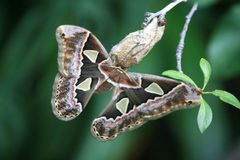
Wingspan of 90–100 mm; wings feature transparent "windows" devoid of that distinguish it from similar . The Forbes (R. lebeau forbesi) is frequently mistaken for the Atlas Moth (Attacus atlas), though the latter is substantially larger with a wingspan reaching 240 mm and possesses a serpent- marking on the forewing lobe.
Images
Habitat
Tropical dry forests and tropical wet forests; found in forested environments from lowland to hilly regions.
Distribution
Lower Rio Grande Valley (United States) through eastern Mexico to Brazil; also recorded from Barro Colorado Island, Panama, and northwestern Rica.
Seasonality
Caterpillar growth and survival are higher in the early wet season compared to the late wet season; and activity follow seasonal patterns tied to plant .
Diet
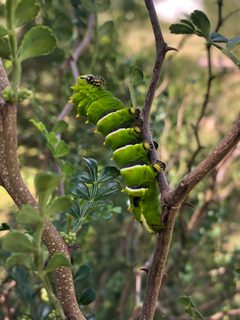
Larvae are herbivorous, feeding on foliage of specific plants. do not feed and have mouthparts.
Host Associations
- Spondias mombin - Larval plantConsistently poor larval survival, long development time, but produces large final size
- Exostema mexicanum - Larval plantHigher larval survival and shorter development time, but produces smaller size
- Casearia nitida - Larval plantVariable intermediate performance between the other two
Life Cycle
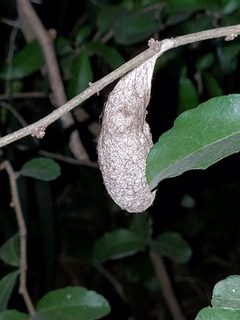
Complete . Caterpillars feed on plant foliage, with development time and survival varying significantly by host and seasonal timing. occurs in a cocoon. emerge with mouthparts, do not feed, and live only a few days. Females invest heavily in production and rarely fly far from their cocoon after , instead emitting species-specific to attract males.
Behavior
Females remain near their cocoons after and emit sexual to attract males; males possess broad wings, streamlined bodies, and sensitive that allow them to detect and follow pheromone trails over distances of a mile or more. Larger males have higher probability of mating, though males of all sizes have been observed mating. Wing damage (indicating relative age) negatively correlates with mating probability.
Ecological Role
Herbivore; component of plant-animal interaction in tropical forests. Serves as for associated protistan microbial .
Human Relevance
R. lebeau forbesi is used in educational exhibits and houses. Relatives in the Rothschildia have cultural significance for peoples, with cocoons harvested to make rattles for ceremonial dances.
Similar Taxa
- Attacus atlasFrequently mistaken for R. lebeau forbesi due to transparent wing windows; distinguished by much larger size (240 mm wingspan vs. 90–100 mm) and serpent- marking on forewing lobe
- Rothschildia cinctaCongeneric giant with similar appearance and
Sources and further reading
- BugGuide
- GBIF taxonomy match
- iNaturalist taxon
- NCBI Taxonomy
- Catalogue of Life
- Celebrate Moths at the Bohart Museum on Saturday Night, July 30 | Bug Squad
- Incredible Work, and Timely, on 22 Species of Hornets | Bug Squad
- Bug Eric: Giant Silkmoths
- A Microbial Observatory of Caterpillars: Isolation and Molecular Characterization of Protists Associated with the Saturniid Moth Caterpillar Rothschildia lebeau1,2
- Fitness consequences of host use in the field: temporal variation in performance and a life history tradeoff in the moth Rothschildia lebeau (Saturniidae)
- Male Body Size and Mating Success and Their Relation to Larval Host Plant History in the Moth Rothschildia lebeau in Costa Rican Dry Forest