
Rothschildia orizaba
Westwood, 1854
Orizaba silkmoth
Rothschildia orizaba, commonly known as the Orizaba silkmoth, is a large in the Saturniidae native to Mexico, Central and South America. First described by John O. Westwood in 1854, this exhibits considerable geographic variation with multiple recognized across its range. Like other giant silkmoths, lack functional mouthparts and do not feed, surviving on fat reserves accumulated during the larval stage. The species has been documented as an occasional pest of coffee plantations, with of larvae requiring approaches.
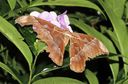
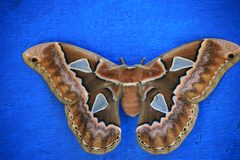
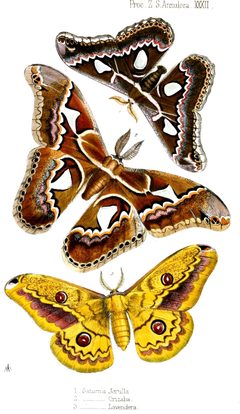
Pronunciation
How to pronounce Rothschildia orizaba: /ɹɔθsˈtʃɪldiə oʊɹiˈsɑbə/
These audio files are automatically generated. While they are not always 100% accurate, they are a good starting point.
Images
Habitat
Found in forest across the Neotropical region. Specific microhabitat preferences within forests are not well documented in available sources.
Distribution
Mexico, Central America, and South America. Documented distributions include: Rothschildia orizaba orizaba (Mexico to Panama), R. o. peruviana (Ecuador, Peru), R. o. equatorialis (Ecuador), R. o. cauca (Colombia), R. o. bogotana (Colombia), R. o. meridana (Venezuela), R. o. triloba ( Rica), and R. o. uruapana (Mexico).
Diet
Larvae have been observed feeding on coffee (Coffea spp.) during documented events. do not feed due to mouthparts.
Behavior
females typically remain near their cocoons after , investing energy in production rather than . They emit -specific to attract males. Males possess broad wings, streamlined bodies, and sensitive that enable them to detect female pheromones from distances of a mile or more. Females deposit eggs on appropriate trees after mating. Both sexes are short-lived as adults, surviving only a few days.
Human Relevance
Larvae have been documented as a pest of coffee plantations, with an in 1989 requiring intervention. Cocoons of related Rothschildia are harvested by peoples for ceremonial use, though specific cultural use of R. orizaba cocoons is not documented in available sources.
Similar Taxa
- Rothschildia lebeau forbesiBoth are large Saturniidae with transparent wing windows; R. lebeau forbesi is frequently mistaken for the Atlas (Attacus atlas) due to similar window patterns, suggesting R. orizaba may share this resemblance.
- Attacus atlasBoth are giant silkmoths with transparent wing windows; R. orizaba may be confused with this due to similar size and wing pattern elements.