
Rothschildia lebeau forbesi
Benjamin, 1934
Forbes' Silk Moth, Forbes Moth
Rothschildia lebeau forbesi, commonly known as Forbes' Silk , is a of giant silkmoth in the Saturniidae. It ranges from the Lower Rio Grande Valley through eastern Mexico to Brazil. are frequently mistaken for the Atlas Moth due to distinctive transparent "windows" in their wings that lack . Like other giant silkmoths, adults do not feed and live only a few days, surviving on fat reserves accumulated during the larval stage.
Pronunciation
How to pronounce Rothschildia lebeau forbesi: /rɔθˈʃɪldiə ləˈboʊ fɔrˈbeɪ/
These audio files are automatically generated. While they are not always 100% accurate, they are a good starting point.
Identification
Distinguished from similar giant silkmoths by transparent "windows" on the wings that are devoid of . Smaller than the Atlas (Attacus atlas), with a wingspan of 90–100 mm compared to 240 mm. Frequently mistaken for Atlas Moth by observers. Distinguished from other Rothschildia by specific wing pattern characteristics, though detailed diagnostic features require examination.
Images
Habitat
Forest , particularly in subtropical and tropical regions. Associated with wooded environments where larval plants occur.
Distribution
Lower Rio Grande Valley of Texas, USA; eastern Mexico; south to Brazil. Present in Middle America, North America, and South America according to distribution records.
Life Cycle
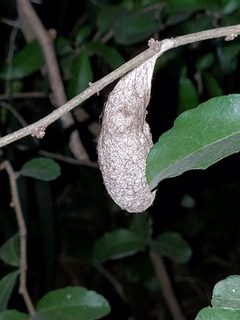
Complete with , larva, pupa, and stages. Larvae are large and heavy at maturity, accumulating fat reserves that sustain adults. Adults emerge from cocoons and do not feed, living only a few days. Females invest most energy in egg production and rarely stray far from their cocoons after emerging, emitting -specific to attract males. Males use sensitive to detect pheromones and may travel a mile or more to locate females. Females deposit eggs on appropriate trees after mating.
Behavior
are short-lived and do not feed. Females remain near their cocoons after , relying on emission rather than to attract mates. Males actively fly to locate females using their sensitive to detect pheromone trails. Both sexes may deposit even without mating.
Ecological Role
serve as prey for bats and other . Larvae function as herbivores, consuming plant material and converting it to that supports adult . The has cultural significance for peoples, with cocoons harvested for use in ceremonial items.
Human Relevance
Cocoons are harvested by peoples in bushel quantities to make rattles worn on the ankles during ceremonial dances. Frequently displayed in houses and gardens for educational purposes. Subject of interest among breeders and hobbyists.
Similar Taxa
- Attacus atlasBoth have transparent "windows" in wings lacking ; Forbes' is frequently mistaken for Atlas Moth by observers, but is substantially smaller (90–100 mm vs. 240 mm wingspan)
- Rothschildia cinctaCongeneric giant with similar and ; both have been displayed together in museum collections