
Eupackardia calleta
Westwood, 1854
Calleta Silkmoth, Ocotillo Silkmoth
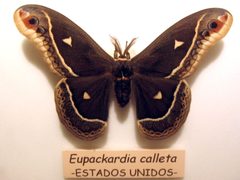
Eupackardia calleta, the Calleta silkmoth, is a distinctive Saturniidae and the sole member of its . Found in the southwestern United States and Mexico, this is strongly associated with ocotillo (Fouquieria splendens), which serves as its primary larval . are and attracted to light. The species is notable for its striking appearance and restricted distribution tied to desert and semi-arid .

Pronunciation
How to pronounce Eupackardia calleta: /juːˌpækˈkɑːr.diə ˈkæl.ɪtə/
These audio files are automatically generated. While they are not always 100% accurate, they are a good starting point.
Identification
The Calleta silkmoth can be distinguished from other Saturniidae in its range by its combination of medium-large size, ocotillo association, and geographic restriction to the southwestern U.S. and Mexico. Within Saturniidae, it differs from the more widespread Eacles and Rothschildia by its specific wing pattern and body proportions. The Eupackardia is , so species-level identification is straightforward once assignment is confirmed.
Images
Habitat
Desert and semi-arid regions, particularly areas where ocotillo (Fouquieria splendens) occurs. include desert washes, rocky slopes, and thorn-scrub vegetation in the Sonoran and Chihuahuan Desert regions.
Distribution
Mexico, Guatemala, and the southwestern United States (southern Arizona, southern New Mexico, and Texas).
Seasonality
have been observed in July and August in Arizona, with peak activity during the summer monsoon season.
Diet
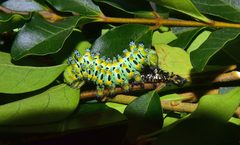
Larvae feed on ocotillo (Fouquieria splendens). do not feed.
Host Associations
- Fouquieria splendens - larval primary plant; ocotillo
Behavior
are and attracted to ultraviolet light. Larvae feed on ocotillo foliage.
Ecological Role
Larvae function as herbivores on ocotillo, a plant in desert . may serve as prey for including bats and owls.
Human Relevance
The is of interest to lepidopterists and collectors due to its restricted distribution and striking appearance. It is not considered an agricultural pest.
Similar Taxa
- Eacles oslariAlso a Saturniidae occurring in the southwestern U.S., but larger and with different wing pattern; not associated with ocotillo
- Rothschildia spp.Other large Saturniidae in the region, but with different wing and plant associations
More Details
Etymology
The 'Calleta' derives from 'calleta,' a Spanish diminutive of 'calla' (ocotillo), referring to the larval plant. The alternative common name 'Ocotillo silkmoth' directly references this association.
Taxonomic notes
Originally described as Saturnia calleta by Westwood in 1854, the was later transferred to the Eupackardia. The genus name honors William Packard, an American entomologist.