
Eupackardia
Cockerell, 1912
Species Guides
1- Eupackardia calleta(Calleta Silkmoth)
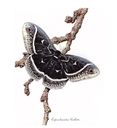
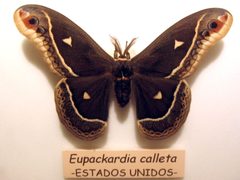
Eupackardia is a in the Saturniidae, containing a single , Eupackardia calleta (the calleta silkmoth). The genus was erected by Theodore Dru Alison Cockerell in 1912. The sole species is notable for its striking black-and-white wing pattern with red thoracic markings, and its caterpillars possess bright aposematic coloration with chemical defenses.
Pronunciation
How to pronounce Eupackardia: //juːpækˈkɑːrdiə//
These audio files are automatically generated. While they are not always 100% accurate, they are a good starting point.
Identification
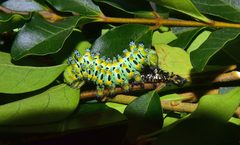
are distinguished from other Saturniidae by the combination of black wings with white post- lines, red thoracic collar, and relatively large size. The white lines are notably wider in females than males. The presence of triangular white spots (when present) further aids identification. Caterpillars are recognizable by their bright green coloration with contrasting white stripes and black scoli with blue-orange bases. The is , so all individuals encountered belong to the single E. calleta.
Images
Habitat
Inhabits thorn scrub vegetation, foothills, and canyons of desert mountain ranges in arid and semi-arid regions. Associated with dry desert environments and riparian corridors within these systems.
Distribution
Mexico, Guatemala, and the southwestern United States (Arizona, New Mexico, Texas). Within Arizona, occurs in the Chiricahua Mountains, Santa Rita Mountains, and Huachuca Mountains.
Seasonality
Activity varies by region and elevation. In southeastern Arizona mountains, are present July–August. In central Arizona to Mexico, adults occur October–January. In South Texas, adults are present September–November and March–April.
Diet
Larvae feed on Fraxinus (ash), Leucophyllum frutescens (ceniza), Sapium biloculare (Mexican jumping bean), and Fouquieria splendens (ocotillo). do not feed.
Host Associations
- Fraxinus - larval food plantash
- Leucophyllum frutescens - larval food plantceniza; primary in some regions
- Sapium biloculare - larval food plantMexican jumping bean
- Fouquieria splendens - larval food plantocotillo
Life Cycle
are deposited in clumps on surfaces of plant leaves, with females beginning to lay at dusk on the day of . emerge in the evening and may mate by early morning (as early as 7:30 am). Males are , females . Young caterpillars (instars 1–3) feed gregariously; older caterpillars (instars 4–5) are solitary feeders. Larvae possess integumental glands that secrete defensive chemicals. occurs in cocoons spun near the ground in shaded locations.
Behavior
exhibit in activity patterns: males are , females . Larvae display ontogenetic shift in social , feeding gregariously when young and solitarily when mature. Caterpillars actively spray defensive secretions from integumental glands when disturbed.
Ecological Role
Larvae function as herbivores on woody desert plants. The serves as prey for various ; larvae possess chemical defenses that deter most predators except certain . Cocoons are subject to by raccoons, opossums, and rodents. pressure appears relatively low compared to other large Saturniidae, though some wasp parasitoids have been reported.
Human Relevance
Cocoons have been traditionally used by Yaqui and other American Indian peoples of Arizona and Mexico for ankle rattles ("tenabares" or "tenevoim") and medicinal necklaces in ceremonial contexts. The is occasionally encountered by entomologists and naturalists in its desert mountain .
Similar Taxa
- RothschildiaSimilar large Saturniidae with black-and-white wing patterns, but lacks the distinctive red thoracic collar of Eupackardia and has different wing venation and pattern elements.
- EaclesRelated Saturniidae with large size and bold coloration, but Eacles typically display green, yellow, or orange coloration rather than black-and-white with red accents, and have different body proportions.
More Details
Conservation status
Not formally assessed; appears to be locally common within its restricted range but -specific.
Etymology
The name honors Packard, likely referring to Alpheus Spring Packard (1839–1905), an American entomologist and paleontologist who contributed significantly to lepidopteran .