
Aspilanta voraginella
(Braun, 1927)
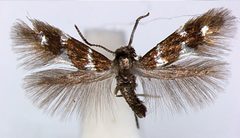
Aspilanta voraginella is a small in the Heliozelidae, originally described by Annette Frances Braun in 1927 and transferred from Antispila to the new Aspilanta based on reduced wing venation and phylogenetic evidence. have a wingspan of 4.7–5.4 mm. The is found in the southwestern United States, where its larvae are gregarious leaf miners on Vitis arizonica.
Pronunciation
How to pronounce Aspilanta voraginella: /æˈspɪlæntə vəˌræɡəˈnɛlə/
These audio files are automatically generated. While they are not always 100% accurate, they are a good starting point.
Identification
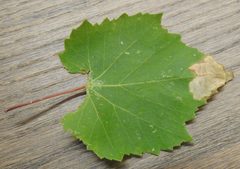
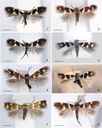
are externally very similar to Aspilanta oinophylla but can be distinguished by dark brown on the . The leaf mine is a white or yellowish blotch lacking any linear portion, often conjoined with other mines on the same leaf. is greenish black and placed irregularly near the center of the mine.
Images
Habitat
Associated with riparian and canyon environments where the plant Vitis arizonica (Arizona grape) grows.
Distribution
United States: Arizona, Texas, and Utah.
Diet
Larvae feed on leaf tissue of Vitis arizonica.
Host Associations
- Vitis arizonica - larval food plantArizona grape, a native North American grape
Life Cycle
are laid on plant leaves. Larvae are gregarious leaf miners that feed on leaf tissue. When mature, larvae cut out a broadly elliptical, somewhat lopsided case from the leaf mine for . Pupation occurs within this shield-like case.
Behavior
Larvae are gregarious, with multiple individuals often mining the same leaf and their mines frequently conjoined. The leaf mine is a blotch type without a linear portion.
Ecological Role
on native grape . Serves as to including Braconidae (Microgastrinae), Eulophidae, and Pediobius.
Similar Taxa
- Aspilanta oinophyllaExternally very similar ; distinguished by dark brown in A. voraginella versus different head scaling in A. oinophylla. A. oinophylla has become on cultivated grapevine in Italy, while A. voraginella remains restricted to native Vitis arizonica in North America.
More Details
Taxonomic history
Originally described as Antispila voraginella by Braun in 1927, transferred to the new Aspilanta in 2021 based on phylogenetic and morphological evidence (reduced wing venation). The genus Aspilanta is confined to North and Central America.
Leaf mine characteristics
The mine is a white or yellowish blotch mine with no linear portion. is greenish black and irregularly distributed near the center of the mine, not along the edges or in discrete lines.