
Aspilanta oinophylla
(van Nieukerken & Wagner, 2012)
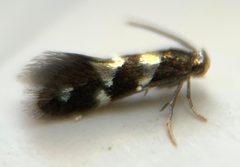
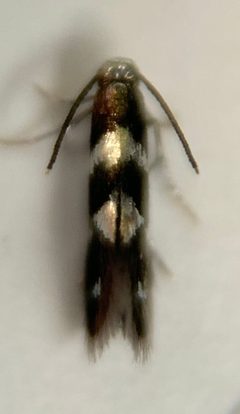
Aspilanta oinophylla is a minute leafmining in the Heliozelidae, native to eastern North America and introduced to Italy where it has become a pest of commercial vineyards. It is the type of the Aspilanta, erected in 2020 for Nearctic heliozelids with reduced wing venation previously placed in Antispila. The larvae feed as leaf miners on Vitaceae, particularly grapevines, and cut characteristic shield-shaped pupal cases from their leaves.
Pronunciation
How to pronounce Aspilanta oinophylla: /æˈspɪlæntə ˌɔɪnoʊˈfɪlə/
These audio files are automatically generated. While they are not always 100% accurate, they are a good starting point.
Identification
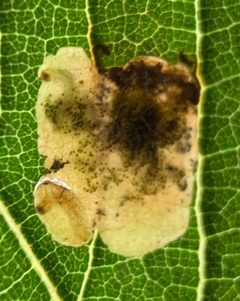
externally identical to Aspilanta ampelopsifoliella; separation requires dissection and examination of genitalia. Distinguished from other heliozelids by reduced wing venation and barcode. Larvae yellowish green with green gut contents, brown and prothorax. Leaf mines diagnostic: begin as linear mines toward leaf , turn at right angle to follow vein, then expand into blotch less than 10 mm²; blackish brown, linear in early portion, concentrated near mine origin in blotch. Mature larvae cut 3.2–4 mm elliptic shield from leaf for , leaving characteristic hole.
Images
Habitat
Native occur in deciduous forests and woodland edges where Vitaceae grow. populations found in commercial vineyards and adjacent semi-natural . Larval habitat is within leaves of host plants; pupal cases overwinter in soil or attached to debris, stakes, and trunks.
Distribution
Native to eastern North America: Canada (Ontario, Quebec) and United States (Connecticut, Georgia, Kentucky, Massachusetts, Minnesota, New York, North Carolina, Oklahoma, Tennessee, Vermont, Wisconsin). Introduced and established in northern Italy (Trento and Veneto regions) since before 2006.
Seasonality
active during growing season of plants; specific period varies with latitude. In Italy, larvae present in vineyards during summer months. Overwinters as pupa in cut shield case, with adults emerging after winter dormancy. Laboratory rearing shows pupal cases survive 1–3°C storage from November to February/March/April.
Diet
Larvae feed as leaf miners on leaf tissue of Vitaceae. plants include Vitis vinifera (common grape), Vitis aestivalis, Vitis labrusca, Vitis riparia, Vitis vulpina, Parthenocissus quinquefolia (Virginia creeper), and Parthenocissus vitacea (false Virginia creeper). In Italian vineyards, shows preference for Chardonnay, Cabernet Sauvignon, and Muscat grape varieties.
Host Associations
- Vitis vinifera - larval common grape; commercial vineyard in Italy
- Vitis aestivalis - larval summer grape; native North American
- Vitis labrusca - larval fox grape; native North American
- Vitis riparia - larval riverbank grape; native North American
- Vitis vulpina - larval frost grape; native North American
- Parthenocissus quinquefolia - larval Virginia creeper; native North American
- Parthenocissus vitacea - larval false Virginia creeper; native North American
Life Cycle
deposited on leaf. Larva mines leaf tissue, creating linear then blotch mine. Mature larva cuts elliptic shield-shaped case from leaf, exits through resulting hole, and descends plant to pupate. Pupa overwinters in case attached to substrate. emerges from case. time presumably or partially depending on climate, but not explicitly documented.
Behavior
Larva constructs leaf mine with characteristic pattern: initial linear portion directed toward , right-angle turn to follow vein, then expansion into terminal blotch. deposition pattern changes from linear (filling mine width) in early mine to concentrated near origin in blotch portion. Mature larva cuts precise elliptic shield from leaf tissue for , leaving clean-edged hole. reach high levels in Italian vineyards, with local causing economic concern.
Ecological Role
Native function as herbivore on wild Vitaceae, likely with limited by natural enemies. In Italy, pest of cultivated grapevines; population suggest enemy release or favorable plant chemistry. Serves as host for including Chalcidoidea, Braconidae (Microgastrinae), and Eulophidae; parasitoids identified as potential agents.
Human Relevance
Significant economic pest in Italian viticulture since 2006 introduction. Leaf mining damage reduces photosynthetic capacity; heavy may impact grape yield and quality. Control research focuses on as agents. Taxonomic confusion with related delayed recognition and management response. Illustrates risks of accidental introduction via international plant material movement.
Similar Taxa
- Aspilanta ampelopsifoliellaExternally identical ; distinguished only by genital . Also native to North America, feeds on Vitaceae including Parthenocissus.
- Antispila speciesPreviously placed in this ; Aspilanta distinguished by reduced wing venation and barcode divergence. Other Antispila generally have complete venation and different associations.
- Other HeliozelidaeSimilar leafmining habit and shield-case ; distinguished by plant, mine , and wing pattern/venation.
Sources and further reading
- BugGuide
- Wikipedia
- GBIF taxonomy match
- iNaturalist taxon
- NCBI Taxonomy
- Catalogue of Life
- Italian vineyards invaded from North America by new species of leafminer | Blog
- Pensoft blog - Part 155
- Splitting the leafmining shield-bearer moth genus Antispila Hübner (Lepidoptera, Heliozelidae): North American species with reduced venation placed in Aspilanta new genus, with a review of heliozelid morphology