
Aspilanta ampelopsifoliella
(Chambers, 1874)
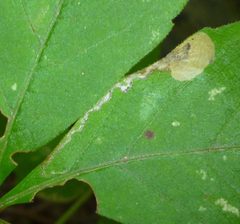
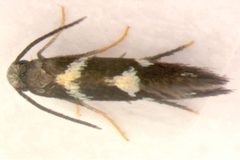
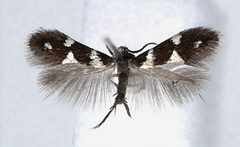
A minute leaf-mining in the Heliozelidae, native to eastern North America. have a wingspan of 5–5.3 mm and are externally indistinguishable from the congeneric A. oinophylla. The larvae create distinctive serpentine-blotch mines in leaves of Virginia creeper and false Virginia creeper, cutting out a shield-shaped pupal case before emerging.
Pronunciation
How to pronounce Aspilanta ampelopsifoliella: /ˌæspɪˈlæntə ˌæmpɪlaʊpsɪfoʊˈliɛlə/
These audio files are automatically generated. While they are not always 100% accurate, they are a good starting point.
Identification
cannot be distinguished from A. oinophylla without genital dissection. Larval mines begin as long, sinuous linear tracks that widen into elongate blotches. initially in a broken linear path, becoming irregularly dispersed in the blotch portion. Mature larvae cut a 3.5–4 mm elliptic case from the leaf, leaving a characteristic hole. plant (Parthenocissus ) and eastern North American distribution help narrow identification.
Images
Habitat
Associated with deciduous woodland edges, forest openings, and anthropogenic where vines grow. Larvae occur on leaves of Virginia creeper and false Virginia creeper.
Distribution
Eastern North America: Canada (Ontario) and United States (Connecticut, Kentucky, Massachusetts, New York, Oklahoma, Rhode Island, Vermont, Wisconsin).
Diet
Larvae are leaf miners that feed on leaf tissue of Virginia creeper (Parthenocissus quinquefolia) and false Virginia creeper (Parthenocissus vitacea).
Host Associations
- Parthenocissus quinquefolia - larval Virginia creeper
- Parthenocissus vitacea - larval false Virginia creeper
Life Cycle
Larvae feed as leaf miners, creating serpentine-blotch mines. When mature, larvae cut out a 3.5–4 mm elliptical shield-shaped case from the leaf for , leaving an elliptic hole in the leaf. occurs in the pupal case.
Behavior
Larvae construct leaf mines that begin as long, winding linear tracks before expanding into blotches. deposition pattern changes from linear to dispersed as larvae mature. occurs within a cut-out leaf case.
Ecological Role
Leaf herbivore; plant tissue consumer. Serves as host for including Chalcidoidea, Braconidae (Microgastrinae), and Eulophidae.
Similar Taxa
- Aspilanta oinophylla are externally indistinguishable; requires genital examination for separation. Larvae feed on grape (Vitis) rather than Parthenocissus.
- Antispila speciesFormerly classified in this ; Aspilanta was erected for Nearctic with reduced wing venation. segment count and wing venation differ.
More Details
Taxonomic history
Originally described as Antispila ampelopsifoliella by Chambers in 1874. Transferred to the new Aspilanta by van Nieukerken & Eiseman in 2020 based on phylogenetic analysis showing reduced wing venation distinguishes this clade from Palearctic Antispila.
Mine characteristics
The linear-blotch mine with changing pattern is characteristic of the . The elliptic exit hole from pupal case-cutting is a -level trait in Heliozelidae.