
Aspilanta argentifera
(Braun, 1927)
Aspilanta argentifera is a minute in the Heliozelidae, originally described by Annette Frances Braun in 1927 and transferred from Antispila to the new Aspilanta in 2020 based on molecular . The is restricted to eastern North America and is a whose larvae feed exclusively on plants in the family Myricaceae. have distinctive silvery-white markings on dark brown forewings.
Pronunciation
How to pronounce Aspilanta argentifera: /æs.pɪˈlæn.tə ɑrˈdʒɛn.tɪˌfɪərə/
These audio files are automatically generated. While they are not always 100% accurate, they are a good starting point.
Identification
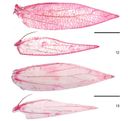
Externally similar to Aspilanta ampelopsifoliella and Aspilanta oinophylla, but distinguished by darker on the . Distinguished from Antispila by reduced wing venation and presence of an spot on the forewing. The leaf mine pattern is diagnostic: begins as a linear track following the midrib toward the leaf tip, then widens into a small blotch extending from midrib to leaf margin, with blackish .
Images
Appearance
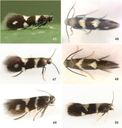
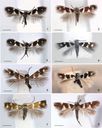
are extremely small with a wingspan of 4.0–5.2 mm and forewing length of 1.8–2.4 mm. The is golden brown with brown . The and forewings are dark brown with bright silvery white markings, including an oblique fascia at one-quarter length, postmedial paired spots, and a small spot. Antennae have 16–20 segments; males lack androconial . Larvae are pale yellowish green with a brown head and prothorax.
Distribution
Eastern North America: eastern Canada (Newfoundland, Nova Scotia, Ontario, Prince Edward Island, Quebec) and northeastern United States (Connecticut, Massachusetts, New York, North Carolina, Vermont).
Diet
Larvae are leaf miners that feed on Myricaceae: sweetfern (Comptonia peregrina), southern bayberry (Morella caroliniensis), wax myrtle (Morella cerifera), and sweet gale (Myrica gale).
Host Associations
- Comptonia peregrina - larval sweetfern
- Morella caroliniensis - larval southern bayberry
- Morella cerifera - larval wax myrtle
- Myrica gale - larval sweet gale
Life Cycle
laid on leaves. Larvae mine leaves, initially creating a linear mine following the midrib toward the leaf tip, then expanding into a blotch mine from midrib to leaf edge. Mature larvae cut out a 2.5–3.5 mm elliptical case from the host leaf for , leaving a characteristic hole. Pupal cases may overwinter.
Behavior
Leaf mining creates distinctive -filled mines with blackish frass. Larvae construct portable pupal cases by cutting out leaf tissue.
Ecological Role
Herbivore; on Myricaceae shrubs.
Similar Taxa
- Aspilanta ampelopsifoliellaSimilar external appearance; distinguished by coloration and plant (Vitaceae vs. Myricaceae)
- Aspilanta oinophyllaSimilar external appearance; distinguished by coloration and plant (Vitaceae vs. Myricaceae)
- Phylloporia bistrigellaFormerly confused with A. argentifera; mines on birch leaves originally attributed to A. argentifera were likely this incurvariid
Misconceptions
Braun's 1927 original description incorrectly identified paper birch (Betula papyrifera) as a plant; a 2020 revision determined these mines belonged to Phylloporia bistrigella, not A. argentifera.
Sources and further reading
- BugGuide
- Wikipedia
- GBIF taxonomy match
- iNaturalist taxon
- NCBI Taxonomy
- Catalogue of Life
- Meloidae Holdings | Entomology Research Museum
- Splitting the leafmining shield-bearer moth genus Antispila Hübner (Lepidoptera, Heliozelidae): North American species with reduced venation placed in Aspilanta new genus, with a review of heliozelid morphology