
Xiphydria
Latreille, 1803
wood wasps, xiphydriid wood wasps
Species Guides
6- Xiphydria abdominalis
- Xiphydria canadensis(Canadian Wood Wasp)
- Xiphydria maculata(Spotted Wood Wasp)
- Xiphydria mellipes
- Xiphydria polia
- Xiphydria tibialis
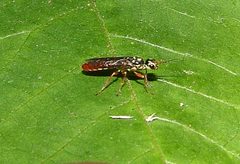
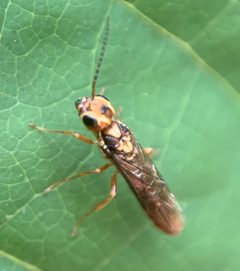
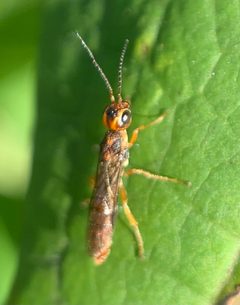
Xiphydria is a of wood wasps in the Xiphydriidae, distributed across the Holarctic region including Europe, Asia, and North America. are characterized by a distinctive elongated 'neck' formed by the long , with approximately 20 segments, and with four teeth. Females oviposit into diseased or dead wood of broadleaf trees and symbiotic fungi that decompose wood for larval consumption. The genus is with one per year. While generally of minor economic importance, some can damage oak and other hardwoods.
Pronunciation
How to pronounce Xiphydria: /ksɪˈfɪdriə/
These audio files are automatically generated. While they are not always 100% accurate, they are a good starting point.
Identification
Distinguished from similar wood-boring by the strongly constricted pronotum in view and the elongated that creates a long 'neck' positioning the away from the . possess approximately 20 segments. have four teeth. The bears a medial tooth-like projection. Hind wing has only two closed . Females have a visible ovipositor. Larvae are white, -like, and resemble siricid larvae but can be separated by -level characters of the .
Images
Habitat
Found in forested and woodland areas where broadleaf trees occur. Associated with diseased, dead, or dying wood including fallen branches and standing dead trees. sometimes found near blacklights.
Distribution
Holarctic distribution: Europe, Asia (including Japan, Korea, Russia), and North America. Specific records include northeastern Asia (Japan: Hokkaido, Honshu, Shikoku, Kunashiri Island; Korea; Russia: Sakhalin, Primorskij Kraj), Türkiye, and North America (United States including Vermont, Connecticut, New York; Canada).
Seasonality
emerge in late summer or fall. with one per year.
Diet
Larvae feed on wood decomposed by symbiotic fungi that females introduce during oviposition. feeding habits are poorly documented; may not feed or may feed on tree sap from wounds.
Life Cycle
Females oviposit into diseased or dead wood, introducing symbiotic fungi via slit-like mycangia at the base of the ovipositor. are gourd-shaped. Larvae bore galleries parallel to wood grain, packing behind them. At maturity, larvae become and reverse direction so galleries run toward the branch exterior. occurs within the gallery. emerge through exit holes approximately 3 mm in diameter. : one per year.
Behavior
Females exhibit drumming on wood surfaces to locate suitable oviposition sites. are non-aggressive and do not sting despite possessing a prominent ovipositor. Males of some exhibit peculiar drumming behavior. Adults are sometimes attracted to blacklights.
Ecological Role
Primary decomposers of dead and dying broadleaf wood through association with symbiotic fungi. Serve as for including Aulacus striatus (Aulacidae) and Rhyssella nitida (Ichneumonidae). Facilitate fungal and of wood substrates.
Human Relevance
Occur in firewood and raw woodworking materials. Usually of little economic importance, though X. longicollis can cause damage to oak wood. Sometimes mistaken for stinging due to size and appearance, causing unnecessary concern. Not venomous and pose no direct threat to humans.
Similar Taxa
- Siricidae (horntails)Both are wood-boring with -like larvae, but Siricidae have oval-shaped versus gourd-shaped eggs in Xiphydria, and Siricidae have pouch-like mycangia versus slit-like mycangia in Xiphydria. Siricidae often have more pronounced 'horns' (cornus) at the tip.
- TremexTremex is a siricid with similar wood-boring habits and appearance, but belongs to a different . Tremex are generally larger and have different wing venation and abdominal structure.
Sources and further reading
- BugGuide
- Wikipedia
- GBIF taxonomy match
- iNaturalist taxon
- NCBI Taxonomy
- Catalogue of Life
- Bug Eric: First Night of Blacklighting
- Bug Eric: April 2024
- Bug Eric: Wasp Wednesday: Pigeon Tremex Horntail
- The Xiphydria annulitibia group in northeastern Asia (Hymenoptera, Xiphydriidae)
- Diversity of xylariaceous symbionts in Xiphydria woodwasps: role of vector and a host tree
- First records of Aulacus striatus Jurine, 1807 (Hymenoptera Aulacidae) and its host, Xiphydria picta Konow, 1897 (Hymenoptera: Xiphydriidae), from Türkiye Aulacus striatus Jurine, 1807 (Hymenoptera Aulacidae) ve onun konukçusu Xiphydria picta Konow, 1897 (Hymenoptera: Xiphydriidae)'nın Türkiye'den ilk kayıtları
- Xiphydria prolongata (Hymenoptera: Xiphydriidae): First North American Hosts and State Records for Connecticut and New York
- Ecological Traits of Three Species of Xiphydria Woodwasps from Japan: Host Tree Species and Eggs, Symbiotic Fungi, and Mucus in Their Bodies
- The complete mitochondrial genome of the woodwasp Euxiphydria potanini (Hymenoptera, Xiphydrioidea) and phylogenetic implications for symphytans.