
Xiphydria abdominalis
Xiphydria abdominalis is a of wood- in the Xiphydriidae, a group of that develop in decaying wood. The Xiphydria contains approximately 15 species in North America. These insects are associated with dead and dying hardwood trees, where larvae tunnel in the wood. are and have been observed flying near material. The species is part of a guild of wood-inhabiting insects that play important roles in forest decomposition processes.
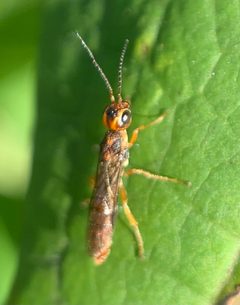
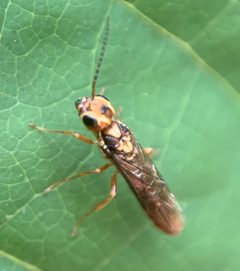
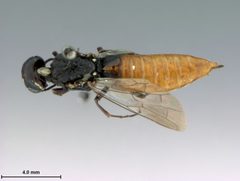
Pronunciation
How to pronounce Xiphydria abdominalis: //zaɪˈfɪdɹiə æbˌdɒmɪˈneɪlɪs//
These audio files are automatically generated. While they are not always 100% accurate, they are a good starting point.
Identification
Xiphydria are distinguished from other wood- by a combination of morphological characters including with 16-20 segments, a pronotum that extends posteriorly to the tegulae, and specific wing venation patterns. Species-level identification within the requires examination of detailed morphological features such as color patterns, punctation , and genitalia structure. Xiphydria abdominalis specifically may be distinguished from by abdominal coloration and pattern, though precise diagnostic features require examination.
Images
Habitat
Deciduous forests and woodlands containing dead or dying hardwood trees. Larvae develop in decaying wood of broadleaf trees, particularly in moist, rotting heartwood. are found in association with larval material and in forested areas where suitable breeding substrates occur.
Distribution
North America. The Xiphydria is Holarctic in distribution, with X. abdominalis occurring in the Nearctic region. Specific range details for this are limited in available sources.
Seasonality
have been recorded in spring and early summer. Based on observations of related Xiphydria and the of wood-, adult activity likely peaks when temperatures warm sufficiently for and tree resources are suitable for oviposition.
Host Associations
- Dead and dying hardwood trees (broadleaf trees) - larval development substrateLarvae tunnel in decaying heartwood
Life Cycle
Complete with wood-boring larval stage. Females oviposit into dead or dying hardwood trees. Larvae tunnel through decaying wood, feeding on wood particles and associated fungi. Development likely spans one or more years depending on conditions. Mature larvae pupate within the wood, and emerge through circular exit holes. Adults do not feed; their primary activity is .
Behavior
are and have been observed flying near dead wood and tree trunks. Females use a long ovipositor to insert into suitable wood substrates. Larvae are solitary tunnelers in wood. The is part of a of wood-inhabiting insects that sequentially colonize decaying trees.
Ecological Role
Xiphydria abdominalis functions as a primary decomposer in forest . By tunneling in dead hardwood, larvae accelerate wood decomposition and nutrient cycling. The creates galleries that may be used by other organisms. As a for such as ichneumonid wasps (e.g., Rhyssella nitida), it contributes to complexity in forest .
Human Relevance
Xiphydria abdominalis has minimal direct economic impact. It is not considered a pest of living trees or timber products, as it confines its development to already dead or decaying wood. The may be encountered by entomologists, foresters, and naturalists investigating forest insect . It contributes to scientific understanding of wood decomposition processes and forest biodiversity.
Similar Taxa
- Other Xiphydria speciesCongeneric share the general wood- body plan and wood-boring ; require detailed morphological examination for separation
- Siricidae (horntails)Similar elongated body form and wood-boring larvae; distinguished by structure, presence of cornus in Siricidae, and different wing venation
- Other Symphyta (sawflies)Shared suborder characteristics; Xiphydriidae distinguished by cylindrical and specific wing venation
More Details
Taxonomic note
Xiphydriidae is a small of approximately 200 worldwide, containing two in North America: Xiphydria and Derecyrtus. The family is considered one of the more primitive lineages within Hymenoptera.
Research significance
Wood- including Xiphydria are important study organisms for understanding forest , wood decomposition, and the evolution of wood-boring in Hymenoptera.
Sources and further reading
- BugGuide
- iNaturalist taxon
- Mini-review of the Cicindelidia abdominalis species-group | Beetles In The Bush
- Ospriocerus abdominalis | Beetles In The Bush
- Bug Eric: First Night of Blacklighting
- Bug Eric: April 2024
- The (almost) Florida-endemic Cicindelidia scabrosa | Beetles In The Bush
- Of Bots and Warbles | Beetles In The Bush