
Pterocheilus sinopis
(Bohart, 1999)
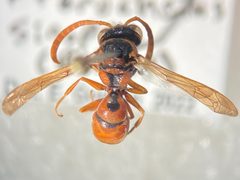
Pterocheilus sinopis is a of solitary mason wasp in the Vespidae, Eumeninae. It is one of approximately 40 species in the Pterocheilus, a group characterized by (burrow-digging) nesting . The species was described by Richard M. Bohart in 1999. Like other members of its genus, females are equipped with specialized anatomical adaptations for excavating soil burrows, including a psammophore (a "beard" of setae on the palps) for transporting soil away from nest sites.


Pronunciation
How to pronounce Pterocheilus sinopis: /ˌtɛroʊˈkaɪləs ˈsɪnoʊpɪs/
These audio files are automatically generated. While they are not always 100% accurate, they are a good starting point.
Identification
Pterocheilus sinopis can be distinguished from other Pterocheilus by genitalic and other morphological features described in Bohart's 1999 revision. The species belongs to the subgenus Pterocheilus sensu stricto. Accurate identification requires examination of and reference to Bohart's original description. Field identification to is supported by observing females engaged in burrow excavation with soil-carrying using the psammophore.
Images
Appearance
Specific morphological descriptions for P. sinopis are not documented in available sources. Members of the Pterocheilus are generally medium-sized eumenine . Females possess a psammophore—a dense fringe of long setae on the maxillary palps used for carrying excavated soil. The wings show longitudinal folds when at rest, a characteristic feature of the Vespidae. Body length in the genus ranges from small to moderately large; the related P. quinquefasciatus measures 13–16 mm in females.
Habitat
Specific preferences for P. sinopis are not documented. Based on -level patterns, Pterocheilus typically inhabit areas with sandy or friable soils suitable for burrow excavation, including grasslands, open woodlands, and badlands terrain. The related species P. quinquefasciatus has been documented nesting in Badlands National Park, South Dakota.
Distribution
The precise geographic distribution of P. sinopis is not specified in available sources. The Pterocheilus shows highest diversity in the southwestern United States, with most occurring west of the Mississippi River. P. quinquefasciatus, the most widespread , ranges from the Rocky Mountains west to the Northwest Territories, eastern Oregon, Washington, and southeast British Columbia, but is apparently absent from Arizona, Nevada, and California.
Seasonality
activity period for P. sinopis is not documented. Based on related , activity likely occurs during warm months when prey caterpillars are available. P. quinquefasciatus has been observed nesting in May.
Life Cycle
The of P. sinopis has not been specifically studied. Based on congeneric , females likely excavate shallow vertical burrows in soil, terminating in a single subterranean . An is laid at the bottom of the burrow, followed by provisioning with paralyzed caterpillars. P. quinquefasciatus provisions with 1–5 caterpillars per cell; P. texanus stores 3–9 caterpillars. Larvae develop on the provisioned prey, with presumably one per year.
Behavior
Females are , excavating burrows in soil for nest construction. They use a psammophore to carry soil away from the burrow entrance and scatter it into the surrounding landscape, effectively concealing nest location from . This has been documented in P. quinquefasciatus and is characteristic of the .
Ecological Role
As a of caterpillars, Pterocheilus sinopis contributes to regulation of lepidopteran . The specific prey spectrum is unknown, but related P. quinquefasciatus preys on caterpillars of Heliothis phloxiphaga (Darker Spotted Straw Moth). Nesting may influence soil structure in local . The species likely serves as prey for various and is subject to by cleptoparasitic insects.
Human Relevance
No direct human interactions are documented. The is of interest to hymenopterists studying the evolution of in solitary . Like most solitary wasps, Pterocheilus are not aggressive toward humans and stings are rare, occurring only if females are directly handled.
Similar Taxa
- Pterocheilus quinquefasciatusMost widespread ; larger size (13–16 mm), distinct distribution (absent from southwestern states where P. sinopis likely occurs)
- Other Pterocheilus speciesApproximately 40 in North America require careful morphological examination for separation; many are poorly known biologically
- Beewolves (Philanthus spp.)Also with similar digging , but belong to Crabronidae; lack the psammophore and wing-folding characteristic of Vespidae
- Other sand wasps (Bembicinae, etc.)Share habits but differ in -level characters and nest construction details
More Details
Taxonomic History
Described by Richard M. Bohart in 1999 as part of his ongoing revisionary work on North American Pterocheilus. The specific epithet 'sinopis' refers to the orange-ochre color of sinopis, a red iron oxide pigment.
Research Needs
Virtually all aspects of the of this remain undocumented, including precise distribution, associations, prey preferences, seasonal , and nesting details. Field observations and photographic documentation would significantly advance knowledge of this poorly known species.