
Pterocheilus quinquefasciatus
Say, 1824
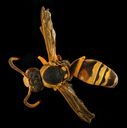
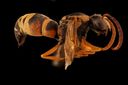
Pterocheilus quinquefasciatus is a solitary mason wasp in the Vespidae, Eumeninae. Females excavate burrows in sandy or soft soil rather than using pre-existing cavities or building mud nests. The is relatively large for the , with females measuring 13–16 mm in body length. It has been documented using caterpillars of Heliothis phloxiphaga (Darker Spotted Straw Moth) as prey in Badlands National Park, South Dakota, with females paralyzing victims and carrying them in to the burrow.
Pronunciation
How to pronounce Pterocheilus quinquefasciatus: //tɛroʊˈkaɪləs ˌkwɪŋkwɪˌfæʃiˈeɪtəs//
These audio files are automatically generated. While they are not always 100% accurate, they are a good starting point.
Identification
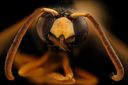
Pterocheilus quinquefasciatus can be distinguished from other vespid by its (burrow-digging) and associated morphological adaptations. Females possess a tarsal rake—stout spines on the front feet used for excavating soil—and a psammophore, a "beard" of long setae on the palps with a fringe of hairs that allows them to carry soil away from the nest entrance. When at rest, females show longitudinal folds in the wings, characteristic of eumenine wasps. The is larger than most , with five pale bands across the (reflected in the specific epithet "quinquefasciatus," meaning "five-banded").
Images
Habitat
Sandy or soft soil environments suitable for burrow excavation. Documented from pinyon/juniper/oak woodland in northeastern New Mexico and Badlands National Park in South Dakota. The requires substrates that allow for digging and soil transport.
Distribution
West of the Mississippi River to the Rocky Mountains, north to the Northwest Territories. Also occurs in eastern Oregon and Washington, and southeast British Columbia. Apparently absent from Arizona, Nevada, and California.
Seasonality
activity documented in late June (June 20–July 9 period in 2023 field observations).
Diet
females provision nest with paralyzed caterpillars. Documented prey includes Heliothis phloxiphaga (Darker Spotted Straw Moth) caterpillars; up to five caterpillars may be stored per cell.
Host Associations
- Heliothis phloxiphaga - preyDarker Spotted Straw Moth caterpillars paralyzed and stored in nest
Life Cycle
Females excavate shallow, vertical burrows terminating in a single subterranean . A single is laid at the bottom of the burrow before hunting begins. The female paralyzes caterpillars, carries them in to the burrow, and stores 3–9 caterpillars per cell before sealing the entrance. Soil is carried away from the nest using the psammophore and scattered to eliminate traces of nest location, reducing risk.
Behavior
nesting with specialized soil excavation and transport. Females use the tarsal rake to dig and the psammophore to carry soil loads away from the nest entrance while backing out of the tunnel. This scattering behavior effectively conceals nest location from parasitic insects. Females hunt caterpillars, paralyze them with venom, and transport prey in to the nest.
Ecological Role
of caterpillars, potentially providing of . Nesting may influence soil structure in sandy . Serves as potential for parasitic insects, though its concealment behaviors reduce risk.
Similar Taxa
- Philanthus spp. (beewolves)Also with similar digging and sandy preferences, but belong to Crabronidae and prey on bees rather than caterpillars. Pterocheilus lacks the dense pile of beewolves and has longitudinal wing folds at rest.
- Other Pterocheilus speciesMost are smaller and less widely distributed; P. texanus makes similar shallow vertical burrows but is smaller and has different distribution.
- Other Eumeninae (mud-nesting mason wasps)Most eumenines use pre-existing cavities or construct free-standing mud nests rather than excavating soil burrows; lack tarsal rake and psammophore adaptations.