
Pterocheilus
Klug, 1805
Species Guides
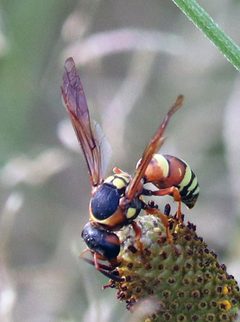
8Pterocheilus is a of mason wasps in the Vespidae, Eumeninae. Unlike most potter wasps that nest in pre-existing cavities or construct free-standing mud nests, in this genus excavate burrows in soil or sand. The genus exhibits its greatest diversity in southwestern North America, with approximately 40 species recognized in the region. Females possess specialized morphological adaptations for digging, including tarsal rakes on the forelegs and a psammophore—long setae on the labial palps used to transport excavated soil away from the nest entrance.


Pronunciation
How to pronounce Pterocheilus: /ˌtɛroʊˈkaɪləs/
These audio files are automatically generated. While they are not always 100% accurate, they are a good starting point.
Identification
Distinguished from other eumenine by the combination of reduced tegulae and conspicuously hairy labial palps. The and associated morphological adaptations (tarsal rakes, psammophore) separate Pterocheilus from cavity-nesting or mud-nesting potter wasps. Females actively digging burrows may be mistaken for beewolves (Philanthus) or other fossorial , but the longitudinal wing folds at rest and overall body proportions reveal their vespid affinities. -level identification requires examination of structural details and often geographic considerations given the concentration of diversity in the southwestern United States.
Images
Habitat
Open, sandy or loose-soil environments suitable for burrow excavation. Documented nesting sites include badlands, sandy prairies, pinyon-juniper woodland edges, and other semi-arid to arid with friable substrates. The shows particular association with western North American landscapes including the Great Plains, Rocky Mountain foothills, and southwestern desert scrub.
Distribution
Primarily Holarctic in distribution, with the vast majority of occurring in North America. The reaches its greatest diversity in the southwestern United States. Pterocheilus quinquefasciatus occurs west of the Mississippi River to the Rocky Mountains, north to the Northwest Territories, with additional in eastern Oregon, Washington, and southeastern British Columbia; it appears absent from Arizona, Nevada, and California. A single Afrotropical species, Pterocheilus eurystomus, is known from Socotra.
Seasonality
activity period varies by and latitude. Pterocheilus quinquefasciatus has been documented nesting in May in South Dakota and observed in Colorado. General activity likely spans late spring through summer in temperate regions, with peak nesting activity probably coinciding with prey availability.
Diet
feed on nectar. Females provision subterranean nest with paralyzed caterpillars as larval food. Pterocheilus quinquefasciatus in Badlands National Park has been documented using caterpillars of Heliothis phloxiphaga (Darker Spotted Straw Moth) as prey, with 1–5 caterpillars stored per cell. Pterocheilus texanus stores 3–9 caterpillars per burrow.
Life Cycle
Females excavate shallow, vertical burrows in soil or sand, terminating in a single subterranean . An is laid at the bottom of the burrow before prey collection begins. The female paralyzes caterpillars, transports them in to the burrow, and stores multiple prey items per cell. After provisioning is complete, the burrow entrance is sealed. The psammophore is used to scatter excavated soil widely, eliminating visual cues that could guide to the nest. Larvae develop on the stored prey, with presumably one per year in temperate regions.
Behavior
Exclusively nesting distinguishes Pterocheilus from most other eumenine . Females dig using modified forelegs with tarsal rakes, either kicking soil backward or carrying it forward in the psammophore to scatter away from the nest entrance. This soil-scattering behavior effectively conceals nest location from . Prey transport involves while carrying paralyzed caterpillars. Males presumably patrol nesting areas or vegetation, as in other solitary wasps, though specific male behavior is poorly documented.
Ecological Role
As of caterpillars, Pterocheilus contribute to natural control of in their . Their specialized nesting represents a distinct ecological strategy among potter wasps, partitioning nest site resources from cavity-dependent species. The serves as for , though the effectiveness of their nest-concealment in reducing rates has not been quantified.
Human Relevance
Minimal direct interaction with humans. Not known to be aggressive; stings would likely occur only through direct handling. The has potential value in given its on caterpillar pests, though no applied use has been documented. Pterocheilus quinquefasciatus is among the more frequently encountered by entomologists in the western Great Plains and Rocky Mountain regions.
Similar Taxa
- Philanthus (beewolves)Also with tarsal rakes, but belong to Crabronidae rather than Vespidae; lack the reduced tegulae and pilose labial palps of Pterocheilus; typically have different body proportions and wing venation.
- Other Eumeninae (cavity-nesting potter wasps)Most eumenines use pre-existing cavities or construct exposed mud nests; lack the specialized digging (tarsal rakes, psammophore) and of Pterocheilus.
- Bembix (sand wasps)Also dig burrows in sand and possess tarsal rakes, but are crabronid with different wing structure, body shape, and prey type (typically flies rather than caterpillars).
More Details
Taxonomic history
The has undergone substantial taxonomic revision, with Bohart (1940, 1996) providing foundational treatments of North American . The subgenus Megapterocheilus was erected for larger species including P. quinquefasciatus.
Conservation status
No are known to be of conservation concern, though the specialized requirements of many species may make them vulnerable to habitat conversion. The Badlands National Park of P. quinquefasciatus represents an important documented nesting site in a protected area.