
Ancistrocerus lineativentris
Cameron, 1906
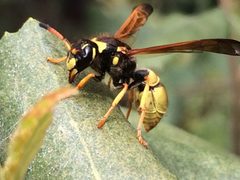
Ancistrocerus lineativentris is a solitary mason wasp in the Eumeninae, Vespidae. It is one of approximately 70 in the Ancistrocerus, which occurs primarily in the Holarctic region. Like other eumenine , it is a solitary nester that provisions its offspring with paralyzed caterpillars. The species was described by Cameron in 1906, but detailed natural history information specific to this species remains limited in published sources.
Pronunciation
How to pronounce Ancistrocerus lineativentris: /ænˌsɪstroʊˈsɪərəs laɪniətɪˈvɛntrɪs/
These audio files are automatically generated. While they are not always 100% accurate, they are a good starting point.
Identification
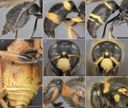
Ancistrocerus are characterized by a prominent transverse carina (ridge) on the base of the first abdominal segment (T1), creating an abrupt angle that the rear of the . This distinguishes them from other eumenine where the slopes more gently toward the thorax. Specific diagnostic features for A. lineativentris are not well documented in accessible literature; identification to species level in this genus typically requires examination of subtle color pattern differences, male genitalia, or other microscopic characters.
Images
Ecological Role
As a solitary mason wasp, Ancistrocerus lineativentris likely functions as a of caterpillars and contributes to local . Eumenine as a group are considered beneficial insects in natural and agricultural due to their caterpillar-hunting .
Human Relevance
Solitary mason wasps including Ancistrocerus are generally not aggressive toward humans and rarely sting. They are considered beneficial insects due to their on caterpillars, some of which are agricultural pests. They do not defend nests aggressively like social .
Similar Taxa
- Ancistrocerus waldeniiAnother Ancistrocerus with similar size and general black-and-pale-marked coloration; distinguished by specific abdominal banding patterns and nest architecture (A. waldenii constructs free-form mud nests attached to hard surfaces)
- Ancistrocerus unifasciatusSimilar size range and general appearance; A. unifasciatus has distinctive yellow facial markings in males and specific abdominal banding patterns, and is known to reuse abandoned mud dauber nests rather than construct free-form nests
- Ancistrocerus campestrisOverlapping size range and geographic distribution; A. campestris has yellow hind margins on the first three abdominal segments and is documented to hunt specific caterpillar (Amphisbatidae, Gelechiidae)
- Other Eumeninae genera (Eumenes, Monobia, etc.)Lack the diagnostic transverse carina on T1; slopes gradually toward rather than having an abrupt angle
More Details
Taxonomic note
Ancistrocerus is a large with approximately 70 globally, predominantly in the Holarctic. Species-level identification is challenging and often requires examination. The genus name derives from Greek 'ankistron' (fish-hook) and 'keros' (horn), referring to the hooked of males in many species.
Data limitations
This has 50 observations recorded on iNaturalist as of the data cutoff, suggesting it is documented but not extensively studied. Published natural history accounts specific to A. lineativentris are sparse; much of what is inferred about its derives from better-studied .
Sources and further reading
- BugGuide
- GBIF taxonomy match
- iNaturalist taxon
- Catalogue of Life
- Bug Eric: Wasp Wednesday: Walden's Mason Wasp, Ancistrocerus waldenii
- Bug Eric: How to (Almost) Catch a Leaf-tier Caterpillar (Video)
- Bug Eric: How to Catch a Leafroller Caterpillar (Video)
- Bug Eric: Eight Illinois Wasp and Bee Mimics in Twenty Minutes
- Bug Eric: City Nature Challenge 2023 Recap