
Macrophya
Dahlbom, 1835
Species Guides
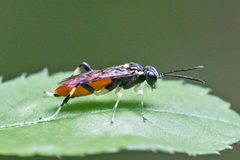
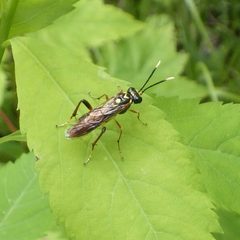
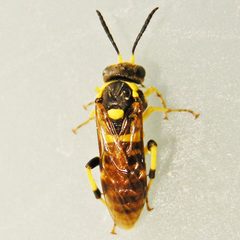
28Macrophya is a of in the Tenthredinidae. The genus contains numerous distributed across Europe, Asia, and North America, with particularly high diversity in China. Several species have been documented as pests of woody plants, including Macrophya satoi, which damages Japanese ash (Fraxinus japonica). The larvae of many species feed on foliage of trees and shrubs. Some species have had their sequenced, including M. alboannulata and M. annulata.
Pronunciation
How to pronounce Macrophya: /məˈkrɒfiə/
These audio files are automatically generated. While they are not always 100% accurate, they are a good starting point.
Identification
Macrophya can be distinguished from other Tenthredinidae by combinations of morphological characters including wing venation, structure, and coloration patterns. Species-level identification often requires examination of genitalia and other detailed morphological features; keys are available for regional species groups such as the M. imitator group, M. sanguinolenta group, M. zhaoae group, and M. sibirica group in China.
Images
Distribution
Europe (including Czech Republic, Denmark, Norway, Sweden); Asia (China, Japan); North America (United States, including Vermont)
Host Associations
- Fraxinus japonica - Macrophya satoi is a serious pest of this Japanese ash
- Chelone spp. - Macrophya nigra larvae feed on these plants
- Various woody plants - Larvae of multiple Central European Macrophya feed on trees and shrubs
Life Cycle
Larvae feed externally on foliage. The has a typical with , larval, pupal, and stages. Larvae of several Central European have been described and illustrated, including M. blanda, M. rufipes, M. diversipes, M. parvula, M. recognata, M. erythrocnema, M. annulata, M. militaris, and M. montana.
Ecological Role
Macrophya satoi serves as for the Priopoda macrophyae (Ichneumonidae: Ctenopelmatinae), representing a documented parasitoid-host relationship in the .
Human Relevance
Some are pests of economically important trees. Macrophya satoi is described as a serious pest of Japanese ash (Fraxinus japonica). Defoliation by Macrophya nigra larvae has been studied in relation to impacts on plants.
Similar Taxa
- TenthredoBoth are in Tenthredinidae with external-feeding larvae; Macrophya is distinguished by specific morphological characters of the , , and genitalia
- PriopodaThis ichneumonid is specifically associated with Macrophya; P. macrophyae is a parasitoid of M. satoi
Sources and further reading
- BugGuide
- Wikipedia
- GBIF taxonomy match
- iNaturalist taxon
- NCBI Taxonomy
- Catalogue of Life
- About Macrophya parvula and larvae of several Central European Macrophya (Hymenoptera: Tenthredinidae)
- Three new species of Macrophya Dahlbom (Hymenoptera, Tenthredinidae) with a key to species of the Macrophya imitator group in China
- Host, Larva, and Life History Notes for Macrophya nigra (Norton) (Hymenoptera: Tenthredinidae)
- Key to the Macrophya sibirica group (Hymenoptera: Tenthredinidae) with description of a new species from China
- Key to the Macrophya zhaoae group (Hymenoptera, Tenthredinidae) with description of a new species from China
- Priopoda macrophyae (Hymenoptera, Ichneumonidae, Ctenopelmatinae), a new species of parasitoid of Macrophya satoi (Tenthredinidae), a serious pest of Japanese ash tree (Oleaceae)
- Effect of defoliation by checkerspot caterpillars (Euphydryas phaeton) and sawfly larvae (Macrophya nigra and Tenthredo grandis) on their host plants (Chelone spp.)
- The genome sequence of a sawfly Macrophya annulata (Geoffroy, 1785).
- The genome sequence of a sawfly, Macrophya alboannulata (Costa, 1859).