
Pristiphora geniculata
(Hartig, 1840)
mountain ash sawfly, rowan leaf sawfly, Ebereschen-Blattwespe
Pristiphora geniculata is a in the Tenthredinidae, native to the Palaearctic region and introduced to North America. It is a specialized herbivore of Sorbus species, particularly mountain ash (rowan). The species exhibits facultative and shows pronounced in larval development, with females having five instars compared to four in males. In eastern Canada, it typically produces two annually, though only one in northern Quebec and at higher elevations in Europe. The species has been the target of successful programs using the Olesicampe geniculatae.
Pronunciation
How to pronounce Pristiphora geniculata: /ˌprɪstɪˈfɔːrə ˌdʒɛnɪkjʊˈleɪtə/
These audio files are automatically generated. While they are not always 100% accurate, they are a good starting point.
Identification
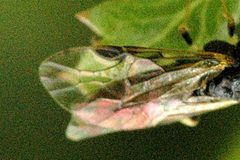
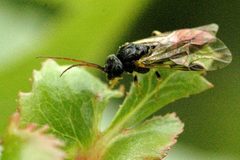
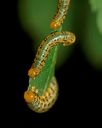
are small, dark-colored with two pairs of membranous wings distinguishing them from true flies. Females possess a saw-like ovipositor used to insert into leaf tissue between epidermal layers around leaflet edges. Larvae resemble caterpillars but can be distinguished by having six or more pairs of fleshy on the (caterpillars have five or fewer pairs) and lacking (hooked structures) on their prolegs. Larvae have black and feed gregariously on foliage. Male larvae develop through four instars, females through five.
Images
Habitat
Associated with stands of Sorbus , particularly mountain ash (rowan). Overwinters as larvae in brown cocoons in leaf litter or soil. In Europe, found in valley systems of the Tyrolean Alps and the Waldviertel region of northern Austria where trees occur.
Distribution
Native to Europe and Asia (Palaearctic region); introduced to North America. In Europe, locally abundant in specific valleys of the Tyrolean Alps and Waldviertel region of northern Austria. In North America, established in eastern Canada (Quebec, New Brunswick, Newfoundland) with spread facilitated by introductions.
Seasonality
In eastern Canada, emerge from late May to early July; hatch in approximately one week; larval feeding lasts two to three weeks. A second, usually smaller begins in late July. In northern Quebec and at higher elevations in Europe, only one generation occurs annually with mature larvae present in August. Some individuals may remain in for up to five years.
Diet
Larvae feed exclusively on foliage of Sorbus , particularly mountain ash (Sorbus aucuparia). Female larvae consume approximately 1.4 times more foliage than male larvae. feed on nectar, pollen, and other insects.
Host Associations
- Sorbus aucuparia - primary plantmountain ash/rowan
- Sorbus spp. - plant
- Olesicampe geniculatae - ichneumonid introduced for ; -specific
- Rhorus sp. - larval ichneumonid, native to Europe
- Eridolius hofferi - larval ichneumonid, native to Europe
- Hyalurgus lucidus - larval tachinid fly, native to Europe
- Mesochorus globulator - hyperparasitoid to North America, attacks Olesicampe geniculatae
Life Cycle
Overwinters as mature larva in a cocoon in litter or soil. emerge late May to early July. Females use saw-like ovipositor to insert into pockets between epidermal layers around leaflet edges. Eggs hatch in approximately one week. Larvae feed gregariously for two to three weeks. occurs in brown cocoons in soil. Two per year in eastern Canada (one in northern Quebec). Some larvae undergo prolonged lasting up to five years. Male larvae pass through four instars, females through five.
Behavior
Larvae feed colonially; isolated young larvae grow slowly and perish, indicating strong survival value of group feeding. are active fliers. Females exhibit arrhenotokous (producing male offspring from unfertilized ), with approximately 61% of reared adults being female.
Ecological Role
Herbivore and occasional pest causing defoliation of mountain ash. Serves as for diverse complex of larval . High rates (often exceeding 90% in Europe) appear to maintain low . Scattered distribution of host trees may limit . Introduction to North America prompted successful program that has suppressed populations to near extinction in Quebec and Newfoundland.
Human Relevance
Considered a pest of ornamental and native mountain ash trees. Subject of one of the most successful programs in North America: introduction of the European Olesicampe geniculatae has reduced P. geniculata to insignificant levels across southern Quebec and Newfoundland, with spread rates of approximately 50 km per year and no major recorded for years following establishment.
Similar Taxa
- Pristiphora rufipescongeneric columbine sawfly with similar and appearance; distinguished by plant association (Aquilegia vs. Sorbus) and geographic distribution
- Pristiphora erichsoniilarch sawfly, congeneric with similar but feeds on Larix laricina rather than Sorbus
Sources and further reading
- BugGuide
- Wikipedia
- GBIF taxonomy match
- iNaturalist taxon
- NCBI Taxonomy
- A Checkered Past, a Checkered Future or Just Checkered? | Bug Squad
- Vanquished vanishing columbines: Columbine sawfly, Pristiphora rufipes — Bug of the Week
- Eastern Larch Beetle Outbreak Keeps Going When Winter's Not So Cold
- Archive — Bug of the Week
- Biologie und Parasiten der Ebereschen‐Blattwespe, Pristiphora geniculata Htg. (Hym.: Tenthredinidae)
- OLESICAMPE GENICULATAE, A NEW PALAEARCTIC ICHNEUMONID PARASITE OF PRISTIPHORA GENICULATA (HYMENOPTERA: TENTHREDINIDAE)
- The Biology of the Mountain-ash Sawfly, Pristiphora geniculata (Htg.) (Hymenoptera: Tenthredinidae), in Eastern Canada
- ESTABLISHMENT OF OLESICAMPE GENICULATAE QUEDNAU AND LIM (HYMENOPTERA: ICHNEUMONIDAE) TO CONTROL THE MOUNTAIN ASH SAWFLY, PRISTIPHORA GENICULATA (HARTIG) (HYMENOPTERA: TENTHREDINIDAE), IN NEWFOUNDLAND
- INTRODUCTION, PERMANENT ESTABLISHMENT, AND DISPERSAL IN EASTERN CANADA OF OLESICAMPE GENICULATAE QUEDNAU AND LIM (HYMENOPTERA: ICHNEUMONIDAE), AN IMPORTANT BIOLOGICAL CONTROL AGENT OF THE MOUNTAIN ASH SAWFLY, PRISTIPHORA GENICULATA (HARTIG) (HYMENOPTERA: TENTHREDINIDAE)